Friday, April 19, 2013

Evolution, Then?


Evolution, Then?


by

Kenny A. Chaffin

All Rights Reserved © 2013 Kenny A. Chaffin


Life on Earth fills the seas, the land and the air; driven by evolution, it has pushed into each and every environmental nook and cranny using mutation and natural selection. One might wonder as you read this if there are not bacteria, viruses or spoors in the Earth’s upper atmosphere that are mutating and evolving to move into and step across space to other planets, other habitable environments -- assuming of course they have not already done so. This may sound implausible, even impossible, but so was the possibility of creatures stepping from salt seas onto dry land, breathing directly from the nebulous atmosphere and going on to plant their footsteps on the Moon.
While the theory of evolution makes no claim as to the origin of life, it clearly delineates the means by which life has diversified and filled our planet. There are a number of origin of life theories but none that is definitive. Life may have drifted in from space after evolving elsewhere, it could have arrived via comet or asteroid or may have actually originated right here on Earth from natural chemical and physical processes. We really don’t know at this point. Should we discover other life, alien life on Mars or elsewhere in the solar system it may give us a clue. If that alien life is our cousin, in other words if it shares our biological and/or genetic processes there is a very good chance life on Earth came from elsewhere – still no guarantee though because Earth life might still have originated here and spread to other places in the solar system. And it’s going to be a very very very long time before (if ever) we can reach out to other star systems and determine if life exists there. In fact we ourselves may have evolved ‘beyond human’ by the time we answer that question.
It seems that the rise of intelligence is an inevitable outcome of evolution so it would not surprise me nor others if we were to someday discover intelligent life in the cosmos – most likely via radio signals – but certainly not necessarily. The universe is a very big place! We seem to be discovering more potentially habitable planets in our galaxy almost daily though so it’s very possible we will be able to determine if those planets harbor life in some reasonable time-frame (e.g. thousands of years). But let’s step back and consider again the mechanism of evolution by natural selection – adaptation and survival in new or changing environments. The random nature of mutations and modifications that become survival mechanisms in certain environments predispose any such system that evolves to create all manner of adaptations. These adaptations provide a basis for individual organisms to survive against competition or in the new or changing environmental conditions. Many of the mutations will fail of course and the individuals or species will die. If we look way back at simple early life forms, some will by mutation evolve pseudopods to reach out and surround food rather than simply waiting for it to drift in or to drift to the food. These pseudopods will over millions of years become fins and flippers used to move though water to escape predation or to capture prey. At some point in our own evolution the ability to breathe air directly became a survival trait and allowed its possessor to slip across dry land to another pond or body of water when its own pond becomes unlivable. This temporary air breathing ability because it allowed the creatures to survive eventually became permanent allowing us to slip the surly bonds of the sea forever.
Even now there may be high-altitude bacteria, viruses or spores poised to in some manner temporarily survive in order to take that step across the barren and deadly environment of space to reach another world, another pond where life can continue. That certainly could be one branch of the evolution of life on Earth but remember evolution is constantly, irrepressibly and simultaneously pursuing all possibilities, even in humans. It may seem that mankind has changed little since the rise of intelligence, but that is not exactly true. We have used our clever minds to provide technological solutions to the environmental changes and challenges around us. We learned to first exploit natural shelters like caves and trees and geological features of the environment to provide a survival mechanism which our biology did not afford us. We went on to find ways of building our own shelters – first clothing such as animal skins and woven plants to shelter us from cold and then to structures – yurts, tee-pees etcetera that could be transported while pursuing the game animals on which we depended for survival. Of course we’ve gone on to build massive skyscrapers and cities. In many ways we have ‘evolved’ to a point where many members of our species would never be able to survive a rough night in the wild, no matter how tame that wild environment might be. (total aside: this is probably a large part of the fascination with survival reality shows).
Let’s push that line of thought a bit further. We have been able to create technology which allowed us to physically step on the moon. This is an incredibly adaptive mutation. Mutation you might ask? Yes, but you have to consider this in a slightly different way than you may normally think of biological evolution. Just as biological mutations such as number and length of fingers, ear shape and hair color are an extension of our biology our technological creations (mutations) are extensions of ourselves as well; ourselves being both our biological and our intellectual abilities. The technological capabilities we create are survival mechanisms just as much so as biologically developed pseudopods, bipedalism or breathing air. The difference is that these adaptations are not physically part of our biological bodies. Yet we are more and more tied and dependent upon the technology we create. You may think of this as good or bad, but really it is neither any more than random biological mutations such as red hair, long fingers or breathing air. Our technology is increasingly an extension of ourselves and we are becoming one with it. We are Borg and increasingly so. Expect it to continue as we become ever more dependent on cars, transportation, cities, food production, technological services, computers, iThings, and Google.
Now then, what does that mean you might ask; what’s the point? That brings us to the “Then?” part of this essays title. Evolution, Then? We have nothing to compare and contrast with at this juncture in our experience as we have not even discovered other life forms or examples of evolution, but assuming this is the natural progression, to move via evolution from inert chemicals to simple living organisms capable of evolving through natural selection to fill an entire planetary ecosystem and then to begin to push even beyond that environment by randomly selecting survival mechanisms within its species such as intelligence and then to assimilate the fruits of that intelligence (i.e. technology) as part of its own plethora of life, what then?
What is next? Maybe we move beyond the physical, perhaps we can transfer our intelligence, our minds into our machines. Is that the next step? Does that fit with the process of evolution? Perhaps, but who’s to say? Evolution necessarily explores any and all options in an effort to reach out, to expand, and to provide a means of survival for life. Even if we could ‘become’ pure information, even that needs some sort of container to sustain it, to provide it energy with which to operate such as our brains or perhaps our future computers. That is not to say there may not be some other means of physically representing life in a more pure informational form such as energy patterns or some such thing, but that step may move completely beyond what we think of as evolution.
How then would it mutate and adapt? Evolution currently requires death in order to do its work. Would death be part of a being that existed as informational patterns of energy? Certainly the simple solution is to provide for the death of individual organisms but allow them to propagate their environmental lessons in survival to their progeny. Perhaps this could be done simply though changes to the information, but again who’s to say? Evolution will likely pursue all these avenues including those spores in the upper atmosphere whom we may meet up with again within a few billion years and when we do I think the biggest question might be will we recognize one another?


Links/References:

Tardigrade:

Brain Simulation:

Brain/Computer Interface:

Comets:


About the Author

Kenny A. Chaffin writes poetry, fiction and nonfiction and has published poems and fiction in Vision Magazine, The Bay Review, Caney River Reader, WritersHood, Star*Line, MiPo, Melange and Ad Astra and has published nonfiction in The Writer, The Electron, Writers Journal and Today’s Family. He grew up in southern Oklahoma and now lives in Denver, CO where he works hard to make enough of a living to support two cats, numerous wild birds and a bevy of squirrels. His poetry collections No Longer Dressed in Black, The Poet of Utah Park, The Joy of Science, A Fleeting Existence, a collection of science essays How do we Know, and a memoir of growing up on an Oklahoma farm - Growing Up Stories are all available at Amazon.com: http://www.amazon.com/-/e/B007S3SMY8. He may be contacted through his website at http://www.kacweb.com

Wednesday, April 3, 2013

The Milky Way Galaxy


The Milky Way Galaxy

(Excerpt from: How do we know? Available on Amazon.com: 

by

Kenny A. Chaffin

All Rights Reserved © 2013 Kenny A. Chaffin


            You’ve seen pictures of our Milky Way Galaxy, right? That beautiful jeweled pinwheel spinning in space that is our home. Anyone would recognize their home wouldn’t they? But wait, where did that picture come from? The Milky Way Galaxy is 100,000 light years across and the furthest man-made camera capable of taking such a picture is only now (after traveling for 35 years aboard the Voyager spacecraft) at the edge of our tiny solar system. A solar system that is located deep inside a spiral arm of that galaxy in the picture. How could we possibly have a picture of it? The truth is we don’t. It’s all made up, an artists simulation. We’ve never actually seen it and probably never will. The vantage point shown in most simulated images would take hundreds of thousands if not millions of years to reach and an equivalent amount of time to send the picture back even at the speed of light. We humans are however quite resourceful and have used our intellect and our instruments to work out how our galaxy would look from a different vantage point.
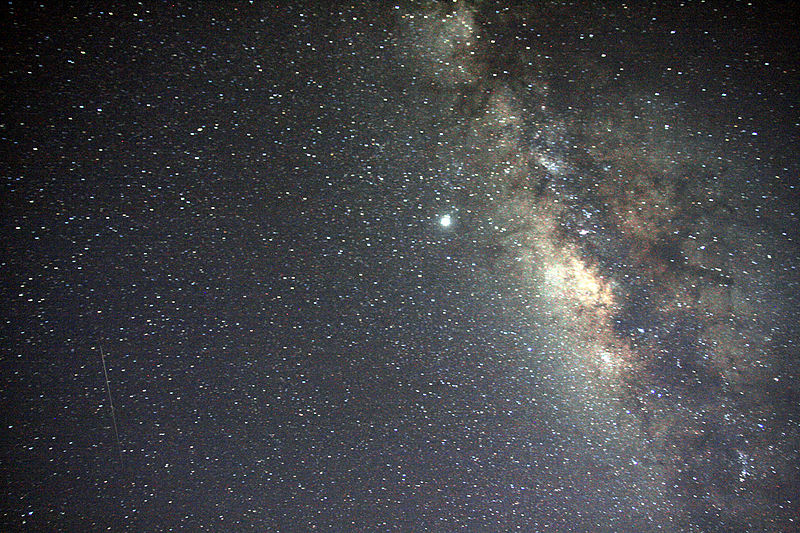
            Via lactea is the Latin name from which The Milky Way is derived. Looking up into the night sky far from the light pollution of our cities it is a glorious sight to see, a glowing whitish milk-like swath of light across the night sky. It was unknown and unexplained for most of our history until Galileo in 1610 trained his telescope upon it and was astounded to find that it is actually composed of millions of tiny stars. We see this swath of glowing light across our sky because we are looking at the other stars in our galaxy edge-on from our vantage point in the Orion Spur about two-thirds of the way out from the center of the galaxy.
            So if we are inside how can we know what our galaxy looks like from outside? It’s a bit like trying to see the inside of your own eye. For that there is a special instrument with mirrors and lenses that will let you see the inside of your eye. To know what our galaxy looks like we use the instrument of science to assemble the pieces, the knowledge we have from observations both by eyesight, optical and radio telescopes, and our rational reasoning in such a way that we are reasonable confident we know what our galaxy looks like. But how? We started with the knowledge provided by Galileo that the milky swath across the sky is actually composed of millions of tiny stars. Knowing nothing else we could assume all stars were the same size and brightness and that the apparent brightness and size of a star would depend on its distance from us. Just as when you approach a car or streetlight the light becomes bigger and brighter the closer you get. The same applies to any other light, including stars. Of course some lights are inherently brighter or dimmer so this must be taken into account. Some stars might naturally be brighter or dimmer than others. If we could assign an average brightness to most stars we could then make a calculated guess as to their distance. But how do we know what distance corresponds to what brightness?
            Here’s where a bit of math and trigonometry magic comes in. Not to delve too far into other areas, but once we know the length and size of the Earth’s orbit around the sun we can use that distance to measure the stars. By locating a near-by (i.e. bright) star such as Andromeda and measuring its position against the far distant stellar background from opposite sides of the Earth’s orbit (e.g. measure the star’s position in June and December or any other 6-month interval) we can use trigonometry with the Earth’s orbital diameter and the angle to the star being measured (relative to the background stars) to determine its physical distance from the Earth.

            Given that, we can assume the same relative brightness for the same type of star and calculate the distance to that star based on its brightness and dimming of the light. This technique is called the ‘standard candle’ technique and is used in various guises throughout astronomy. It can be used to measure within our solar system, galaxy or between galaxies depending on what light source is being used as a standard candle.  Simple right? Of course this method is fraught with potential error and assumptions. Assumptions such as all similar stars having the same brightness, interstellar space being free of gas and dust which could affect the brightness of distant stars (this of course we knew, or guessed simply from looking at the Milky Way and its dark areas and wondering why there were no stars there).  More recently we've been able to observe the universe with infrared, x-ray and radio waves which allow us to see through interstellar dust and gas and validate optical measurements and obtain measurements we could never get through an optical telescope. 


The Milky Galaxy

            So to get back to the Milky Way and how we know what it looks like, we can measure the distances to the visible stars and plot them on a three dimensional graph. When we do we get a good approximation of a spiral type galaxy.
We know from Hubble’s discovery of distant galaxies that there are only a few types of galaxies – the spiral galaxy being one of the most prominent. So we make an assumption.

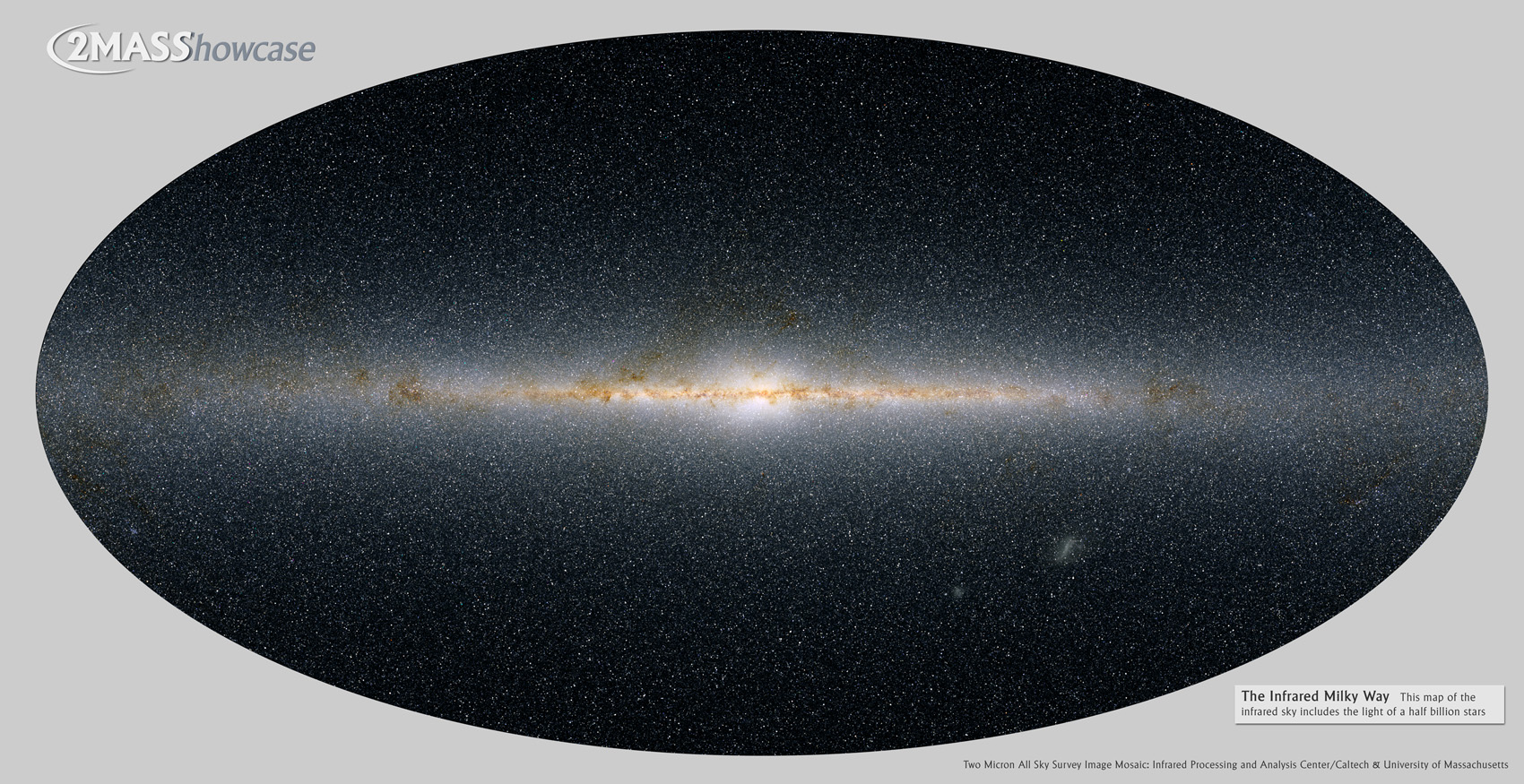
            From infrared surveys (infrared light passes through interstellar dust and gas) we get a reasonably clear picture of our galaxy from our position within it without the dust blocking other stars. 


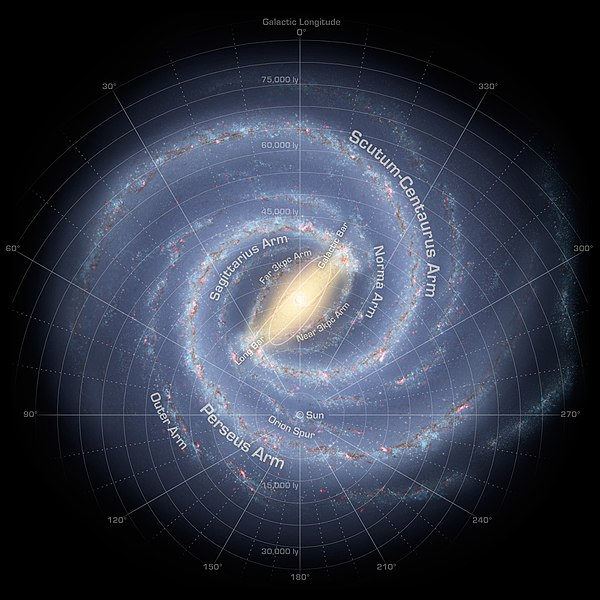
            Additional detailed measurements and plotting of stars reveals further that our galaxy is not a true spiral galaxy, but a ‘barred’ spiral meaning that there is flat rectangle bar of stars extending from the central bulge. Even given our outstanding astronomical equipment there is still controversy over the number and size of the spiral arms and spurs such as the Orion Spur to which our sun and solar system belongs. 


This is a current artist’s conception of our galaxy based on data from NASA. The Sun is located at the lower center with the coordinate graph radiating from it.

            It is thought that there is a supermassive black hole at the center of our Milky Way galaxy just as there are in the centers of other galaxies. There is no danger in this as we are some 25-30,000 light years from the galactic center (depending on the calibration of our standard candles). We still have much to learn about galactic formation and that will be a topic for another of these essays. It could be that the black hole is the reason the galaxy forms around it or alternatively it could be that the gravity at the center of the spinning galactic disc prompts the formation of a supermassive black hole.
Using our radio telescopes, the Chandra x-ray observatory, the Hubble and James Webb space telescopes as well as others in all the various bands of the electromagnetic spectrum we will continue to refine our measurements and knowledge of what the Milky Way Galaxy looks like from outside as well as the interior details. We’ll never actually know for certain what it looks like from the perspective shown above (unless of course we suddenly invent some kind of warp drive that can take us there) but with science we will continue to refine our concepts of our galactic home and what it looks like to others from their homes in galaxies far far away.


References/Resources/Links

Milky Way Galaxy:

Mapping the Milky Way:

Milky Way Galaxy:

2Mass Sky Survey:

Nasa Milky Way Artist Simulation:

Cosmic Distance Ladder (measurement):


About the Author

Kenny A. Chaffin writes poetry, fiction and nonfiction and has published poems and fiction in Vision Magazine, The Bay Review, Caney River Reader, WritersHood, Star*Line, MiPo, Melange and Ad Astra and has published nonfiction in The Writer, The Electron, Writers Journal and Today’s Family. He grew up in southern Oklahoma and now lives in Denver, CO where he works hard to make enough of a living to support two cats, numerous wild birds and a bevy of squirrels. His poetry collections No Longer Dressed in Black, The Poet of Utah Park, The Joy of Science, A Fleeting Existence, a collection of science essays How do we Know, and a memoir of growing up on an Oklahoma farm - Growing Up Stories are all available at Amazon.com: http://www.amazon.com/-/e/B007S3SMY8. He may be contacted through his website at http://www.kacweb.com


Saturday, March 2, 2013

To the Stars!


To the Stars!


by

Kenny A. Chaffin

All Rights Reserved © 2013 Kenny A. Chaffin


It all sounds so easy in science fiction; Captain Kirk and Spock zooming around the galaxy, stopping off at Vulcan, fighting the Romulans across parsecs and encountering Lizard creatures on the other side of the galaxy. For the Enterprise with its dilithium crystals and warp drive it takes no time at all to cover millions of (light) years, but our Voyager I and II spacecraft – the fastest things in the sky --  traveling at 17.26 km/s (10.72 mi/s) are only now after 35 years reaching the edge or our solar system. Assuming they were traveling in the right direction, it would take another 70,000 years to reach the nearest star system – Alpha Centauri only 4.2 light years away.
It so happens that 70,000 years ago we humans almost bit the big one. Genetic analysis reveals that at that time the human race consisted of no more than 15,000 individuals most likely located in Southern Africa. Most scientists place the blame on the massive Toba volcanic eruption that blanketed the planet in ash, killed off many species and affected all life on Earth. Others suggest that the human catastrophe may have been due to disease or other causes but the timing of the eruption is extremely coincidental if nothing else. We survived and that crisis may have actually pushed us further and harder in our evolution than ever before but the key thought here is to consider the changes the human race has been through in the past 70,000 years and where we might be 70,000 years from now when a probe of human origin finally arrives on its one-way trip to Alpha Centauri. It would take another 70,000 years to return or should we decide to have it phone home we’d only have to wait an additional 4.7 years to receive the radio signal saying, “Mom, we’re here, we made it!” Given humanity’s history and status, you have to wonder if we will even be around in 700 centuries. Which brings us back to, can we ever realistically hope to reach other suns? Other planets? Can we even know if there is anyone or anything out there?
Not to be a downer, a party pooper, an Eeyore, but the bottom line is we may never know. We must face up to the reality that space is a damn big place! Bigger than anyone, or most anyone can even imagine. Perhaps you can begin to imagine it given the 70,000 year example above, but that is only to reach the single closest star to our sun. There are millions of suns in our Milky Way Galaxy which is itself 120,000 light years across – at Voyager speed it would take 2 billion years to cross and that would be without slowing down or stopping for potty breaks. The Earth itself at 4.7 billion years old is only a bit more than twice that galactic transit time. And that is only our galaxy, there are millions of galaxies out there far beyond our Milky Way. The nearest being the Andromeda Galaxy 2.5 million light years away. To reach Andromeda at Voyager speed would take 200 billion years and given that the universe itself is only 13.8 billion years old, that’s a long, long, long time!
To bring this back down to Earth, I know that when I look up at the night sky I’m filled with awe, watching Orion make his way across that sky, seeing the Big Dipper and the North Star -- visible even from my back yard in the city. And that view has no comparison to the immense view of the sky and stars visible in my youth growing up on a farm far from city lights. There the naked eye view of the Milky Way could make anyone weak in the knees. The millions of stars sparkling and the arcs of traveling satellites like Echo I and Telstar filled me with possibilities far beyond the cotton fields surrounding me. Even today in my light-polluted back yard while gazing in awe at the night sky I am starkly aware of the millions of years the light from those stars has traveled only to end its journey by striking my retina to register as a sparkle of light in my brain. And that thought creates an even greater sense of wonder inside me. This sort of experience makes it clear to me why ancient peoples filled with this spirit, this awe, this sense of wonder, adopted religion, rituals and worship of the world and the wonders around them.
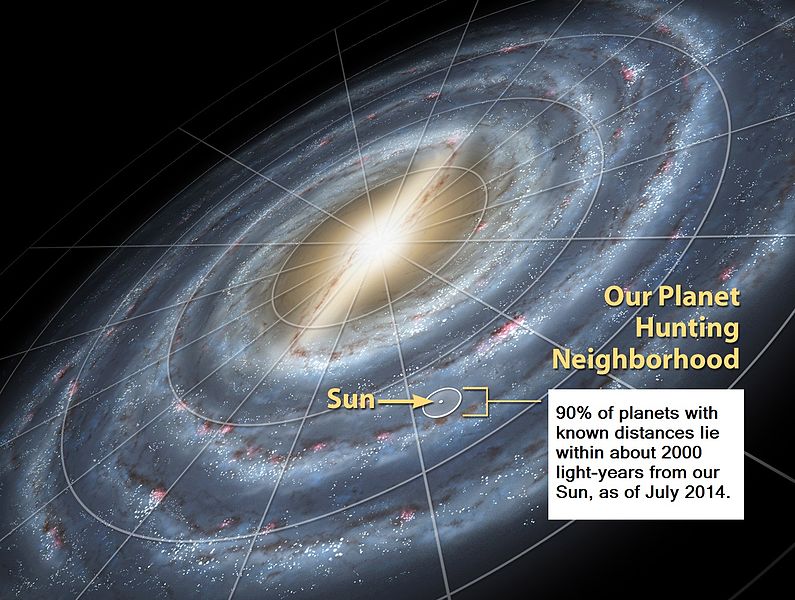
Our space and terrestrial telescopes continue to improve and astronomers have recently discovered a number of “Earth-like” planets with the possibility of harboring life. They are in the so-called habitable zone and may have liquid water. One of these, HD40307g is virtually next door, only 44 light years away -- still ten times further than Alpha Centauri, but potentially harboring life (no such planets have been detected in the Alpha Centauri system). At that distance our radio signals from 44 years ago would just now be reaching them.


Image courtesy NASA/JPL

In 1968 the Vietnam War would be in full swing, in January of that year the Tet Offensive -- one of the bloodiest hard-fought battles of that war would take place, the political protests against the war would be a constant in the news broadcasts, the hippies, the flower children and sex, drugs, and rock and roll would be everywhere that year following The Summer of Love. Martin Luther King would be assassinated in April followed by Robert Kennedy in June. Apollo 7 would orbit the Earth and Apollo 8 would swing around the Moon at Christmas time. Radio and TV signals of all these things would begin their trek towards HD40307g reaching there 44 years later in 2012.
But is anyone there, is anyone listening? And if so, what might they have already learned from the signals we’ve beamed into space for the past century? The first public radio broadcast was in 1910 of the Metropolitan Opera. Now if you happen to be scared of aliens like Stephen Hawking you can probably relax because if that opera stuff doesn’t scare them away, nothing will! But seriously, we have been beaming our signals and our presence into space for the last century. There is a bubble, a wave front of information 100 light years out there centered on Earth traveling at the speed of light and available to be decoded by any technologically capable society. It will continue to travel and gradually weaken as it does.
We are not just beaming our presence out even if inadvertently, we are also listening. SETI (the Search for Extra Terrestrial Intelligence) in various guises, incarnations and funding levels has been listening and searching since 1960 when it was started by astronomer Frank Drake (of Drake equation fame) and held its first conference in 1961 organized by Peter Pearman and attended by Drake, Carl Sagan and seven other astronomers, scientists, and inventors. Unfortunately nothing resembling intelligent signals have been detected though there have been a number of embarrassing misinterpretations. The latest variant is SETI@Home which is a distributed computing collaboration that uses volunteers’ home computers to analyze wide-band data collected from the SERENDIP IV system which piggybacks on top of astronomers scheduled observations. The hope is to isolate and identify signals that could be originating from intelligent extraterrestrial sources. Despite half a century of focused listening and massive passive observation from radio telescopes and other radio receivers, we’ve heard nothing, not a peep that could be consider intelligent extraterrestrial signals. As far as we know we are alone.
            Is there any chance what-so-ever we will ‘reach’ the stars? Again, not to be negative, but given current physics and astrophysics the odds simply are not good – worse even than winning the lotto. We may or may not be able to visit Mars, our closest neighbor planet in the near future, but even to establish a long-term or permanent outpost there is highly unlikely in the foreseeable future.
All-righty then, but what about travel to the stars themselves? Are there no generation ships, no poorhouses, no jails? Certainly there has been serious speculation and planning (such as Project Daedalus) for interstellar manned or unmanned missions and while building self-sustaining spaceships capable of traveling to other stars is perhaps on the bleeding edge of possibility in the long-term future where would we send them, which direction, and why?
Radio waves are our most likely means of detecting/contacting extraterrestrial intelligence, but against the backdrop of the cosmos even radio waves are slow. And given the miniscule amount of time we have been listening it is not even really possible to speculate on whether we might someday detect life out there, but it is not unreasonable to assume that we may never know.
            On a brighter side of that coin however, given what we do know of physics, chemistry and life the odds are excellent that not only life, but intelligent life has arisen millions of times throughout our galaxy as and in the millions of other galaxies that make up the known universe. While we may never know or be able to verify directly that life is out there, we can be relatively confident that we are not alone. And with that in mind, let us raise a glass and make a toast, “To the Stars!”


Links/References:


Fastest Spacecraft:

Voyager Missions:

Extinction or a Future in the Stars:

SETI:

Project Daedalus:


Planet hunting neighborhood image:


About the Author

Kenny A. Chaffin writes poetry, fiction and nonfiction and has published poems and fiction in Vision Magazine, The Bay Review, Caney River Reader, WritersHood, Star*Line, MiPo, Melange and Ad Astra and has published nonfiction in The Writer, The Electron, Writers Journal and Today’s Family. He grew up in southern Oklahoma and now lives in Denver, CO where he works hard to make enough of a living to support two cats, numerous wild birds and a bevy of squirrels. His poetry collections No Longer Dressed in Black, The Poet of Utah Park, The Joy of Science, A Fleeting Existence, a collection of science essays How do we Know, and a memoir of growing up on an Oklahoma farm - Growing Up Stories are all available at Amazon.com: http://www.amazon.com/-/e/B007S3SMY8. He may be contacted through his website at http://www.kacweb.com