Wednesday, September 4, 2013

A Visitor from the Oort Cloud

A Visitor from the Oort Cloud


by

Kenny A. Chaffin

All Rights Reserved © 2013 Kenny A. Chaffin


(Note this post was written before the feeble appearance and flyby of Comet ISON, nevertheless it contains some relevant information about comets, the Oort Cloud etc.)


This November you may see the most spectacular celestial event of your life. Comet ISON (officially known as C/2012 S1) is due to make its closest approach to the Sun on November 28, 2013 and if indications are correct it will be as bright as the full moon and may even be visible in daylight with a magnitude of -11.6.
Comet ISON is named after the Russian observatory - the International Scientific Optical Network (ISON) near Kislovodsk where it was discovered by Vitali Nevski and Artyom Novichonok on September 21, 2012. At that time it was still 625 million miles from Earth.
This event may very well be one they are talking about 1000 years from now long after you and I are gone. But as with all comets though there is much guesswork involved. If it should breakup before it gets close to the Sun there may be no sky-show at all. The spectacularation is also dependent on the comet’s composition which of course varies from comet to comet. Comet hunter David Levy says, “Comets are like cats, they have tails, and they do precisely what they want.” We’ll simply have to wait and see what happens but given the indicators (such as the photographs by the NASA probe Deep Impact on January 17 and 18) it will be truly awesome. I’m betting it will outshine my experience of Halley’s Comet which I saw put on a show in 1986.

File:ISON Comet captured by HST, April 10-11, 2013.jpg
Comet ISON on April 10, 2013 taken by the Hubble Space Telescope.
Image courtesy of NASA.

Comets are things of imagination, fascination and lore. With their long luminous tails sweeping across the sky, their unusual movement against the fixed stars of the night sky and their unpredictable appearances they were clearly of a fantastical and dream-like nature and have long been thought of as bad omens. Still the biblical star of Bethlehem may have been a comet and the 1066 comet over the Battle of Hastings was no less than the well-known Halley’s Comet itself, perhaps the most famous of all comets and one that was key in establishing the nature and science of comets. Halley’s is a short period comet and that was helpful in identifying it as a recurrent visitor to our inner solar system. By tracking its path and calculating its orbit Halley in 1705 was able to predict that it would reappear every 76 years and also confirm many historical observations. It has been reliably recorded since 240 BCE and will next appear in mid-2061. Odds are not in my favor for being around barring significant medical breakthroughs in age extension, but hopefully you will be there to see it.
 Long period comets like Comet ISON are somewhat more difficult to predict as small variations in their paths and changes in their mass as they approach the sun can result in significant variations in their predicted return. These long period comets may not return for hundreds or thousands of years. The difference in short and long period comets is in their origin and the path they follow around the sun. They each come from different regions of our solar system. The short period comets originate and travel from an area known as the Kuiper Belt which is just past Neptune within the outer reaches of our planetary space. The long period comets like ISON originate in the Oort Cloud which is vastly further away.

Artists rendering of the Kuiper Belt and Oort Cloud. Courtesy NASA.

No one has seen the Oort cloud; not Hubble, not Sagan, not Voyager, not even Halley though the comet named for him was a large impetus for its conception. There have been ancient and historical accounts of comets appearing in the skies, the Chinese observed Comet Halley in August and September of 12 BC. Because comets are so unusual and different with their movement and huge glowing and streaming tails they were terrifying to the ancients. People would hide or perform sacrifices or other bizarre behaviors when a comet appeared in the sky; though that may not be much different than today given the strange cult behavior during recent comet appearances. Eventually though more scientific oriented minds began to ask what are they? Where do they come from? These thoughts led Ernst Opik in 1932 to postulate the existence of a vast cloud of material surrounding our solar system and for Jan Hendrik Oort to come to the same conclusion in 1950. The behavior of comets – the ‘boiling away’ of their mass as they approach the sun and its warmth creates their spectacular tails and this thought to preclude them being formed near the sun. The hypothesis was then that they were from some far domain, some cometary cloud that had existed since the formation of our solar system and only some gravitational perturbation would cause a comet to begin a journey to the gravity well of our sun. Many of those journeys would end up with collisions of the comet with planets or a final plunge into the sun itself. Others on slightly different trajectories would enter the solar system swing around the gravity well of the sun and be returned one again to the far reaches of the solar system -- only to return again. Oort used the trajectories of the comets along with his knowledge of the solar system and of the cosmology knowledge of the day to describe and determine the distance, extent and makeup of the speculative cloud that came to bear his name. 
The Oort cloud itself is a spherical cloud of material surrounding our solar system centered on the Sun.  Its outer edge lies approximately one light year or 50,000 Astronomical Units (1 A.U. = 93 million miles) from the sun. An additional reason the Oort Cloud is of note is that its outer edge marks the furthest extent of gravitational influence from the Sun and planets. In attempting to comprehend this vast distance we might think about the current furthest man-made objects from the Earth -- the Voyager spacecraft -- currently 123 AU from the sun well beyond the Kuiper belt and are just entering (as of December 2012) ‘interstellar’ space yet still far from the Oort Cloud. Voyager’s trip so far has taken 35 years and will require another 10,000 years to reach the Oort Cloud – far longer than humanities recorded history on Earth.
Since no one has ever seen the Oort cloud our information about it is based on secondary observations such as those long-period comets like ISON, simulations and logical inferences about the formation of the Solar system and we speculate that other solar systems have Oort clouds as well, but given the density and the difficulty we have with even detecting planets around other stars detecting an extra-solar Oort cloud is pretty much out of the question given our current capabilities. We believe the Oort Cloud consists of two parts, a spherical outer shell some 20,000- 50,000 AU and an inner doughnut-shaped cloud of 2000- 20,000 AU from the Sun. This inner portion is called the Hills Cloud for J.G. Hills who proposed its existence in 1981.
Based on the comets we have observed it is believed that the cloud is comprised of trillions of icy objects larger than 1 km. The ices are thought to be water, methane, ethane, carbon monoxide and hydrogen cyanide though some may be rocky asteroid-type objects. All together it is thought the mass of the Oort cloud is about 5 times the Earth’s mass – virtually nothing given the volume of space it covers. It is no wonder we can’t see it! Still a few objects have been detected and are thought to be part of the Oort Cloud, the most well know and biggest is Sedna discovered in 2003 and thought to be some 1500 km in diameter.
            One reason comets are of interest – other than making disaster movies and creating end-of-life-as-we-know-it scenarios and speculation is the possibility that comets were the bearers of water to our planet and possible even the bearers of life itself or the components thereof. This idea of course has been questioned and continues to be questioned. Since we have established that comets do contain a significant amount of water as well as other ices this seems a reasonable possibility. But it is also just as possible is that the Earth and comets formed from the same protoplanetary substances and thus both contain water. This second scenario however does not explain is why we don’t see water on the other solar system planets and moons – though there may be other explanations for that. This cometary delivery of water has also been questioned because of the make-up of the water ice in the comets which we’ve been able to determine using spectral analysis. Earth’s oceans contain a significant percentage of ‘heavy’ water - deuterium. Our analysis of comet Halley and comet Hyakutake, both originating in the Oort cloud give ratios of deuterium to normal hydrogen that is twice that of Earth’s oceans. Conversely analysis of Comet Hartley2 and Comet LINEAR (originating in the Kuiper belt) show it has the proper ratio. It is thought the origin of these comets from different parts of our solar system accounts for their difference in composition. So there appear to be at least two measurable differences in the types of comets we see, their composition and their orbital period – either short or long period comets. This seems to make sense in that comets from vastly different parts of the solar system (Kuiper belt or Oort cloud) would have different compositions based on the way the initial protoplanetary disk originated and formed the objects in our solar system.
Interestingly then based on composition it would appear Halley’s Comet actually originated in the Oort cloud but has through gravitational perturbations become a short period comet now traveling from the Kuiper belt around the sun while Comet ISON remains a long period comet and will only be visiting us for a short time later this year and then beginning its long climb out of the solar well to the far reaches of the Oort cloud.
As far as ISON, it is still 475 million miles away as of January 18, 2013 but already has a tail more than 40,000 miles long. It is going to be spectacular! Plan your comet watching party now while there is still time. I’m very much looking forward to it and as it may be the last really spectacular celestial light show I’ll see and I’d love for it to outshine my memories of those 60’s and 70’s concert light-shows! I've got a feeling it just might. Take care and enjoy the show!


References/Links:


Oort Cloud:

Oort Cloud Image:

Kuiper Belt and Oort Cloud:

Comets:


Where did Earth get its water:


Comet ISON:

Comet ISON Image:


About the Author

Kenny A. Chaffin writes poetry, fiction and nonfiction and has published poems and fiction in Vision Magazine, The Bay Review, Caney River Reader, WritersHood, Star*Line, MiPo, Melange and Ad Astra and has published nonfiction in The Writer, The Electron, Writers Journal and Today’s Family. He grew up in southern Oklahoma and now lives in Denver, CO where he works hard to make enough of a living to support two cats, numerous wild birds and a bevy of squirrels. His poetry collections No Longer Dressed in Black, The Poet of Utah Park, The Joy of Science, A Fleeting Existence, a collection of science essays How do we Know, and a memoir of growing up on an Oklahoma farm - Growing Up Stories are all available at Amazon.com: http://www.amazon.com/-/e/B007S3SMY8. He may be contacted through his website at http://www.kacweb.com

He may be contacted through his website at http://www.kacweb.com

Tuesday, July 23, 2013

Hotspots Calderas and All That (Excerpt from: How do we know? )

Hotspots Calderas and All That

(Excerpt from: How do we know? Available on Amazon.com: 


by

Kenny A. Chaffin

All Rights Reserved © 2013 Kenny A. Chaffin


Yellowstone is well past due for a massive eruption. The magma chamber 6 miles beneath it is growing larger and faster than at any time in human history. We know that Yellowstone erupts every 600,000 years or so and the last eruption was 642,000 years ago. Now while past performance does not guarantee future events, we are past due for this one. Past eruptions occurred 2 mya (million years ago) and 1.3 mya as well. These were massive eruptions 1000-2000 times that of the Mt St. Helens eruption of 1980. 


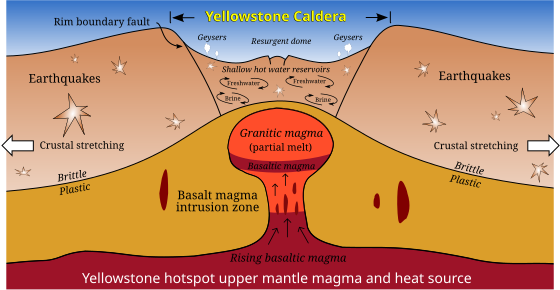
This image shows the basic geology of the Yellowstone area and caldera. This area and others like it around the world are caused by mantle plumes.

            By examining and mapping the terrain of the area each of a few recent eruptions can be seen in the separate calderas they left. These are indicated in this image from the U.S. National Park Service.


            The three most recent eruptions (2.1, 1.6, and .6 mya) are all in the current Yellowstone area as shown in the previous caldera image. The following image shows the movement of the hotspot back some 16 million years into Oregon and Nevada. It is a bit deceiving but it’s not the hotspot that is moving, it is the crust of the Earth moving above and across it. The hotspot rises up from the magma layer below and the North American continental plate moves from North/East to South/West above the hotspot as the continent makes its way steadily and irrepressibly towards the Pacific subduction zone under California. This makes it appear as though the hotspot is moving to the east/northeast but it is actually the continent moving over the hotspot.  


            Each past eruption has been unique with varying impacts on the geography, fauna and flora. We can see this by examining the geological evidence in the ash it expelled in amount and extent as well as the evidence of pyroclastic and lava flows. The smaller eruptions seem to have devastated life in the four surrounding states – Idaho, Wyoming, Colorado and Nebraska. The larger eruptions devastated the entire western half of the United States from Canada to Mexico and from the Pacific Ocean to the Mississippi River.
Scientists are constantly watching, measuring and monitoring any movement, tremors, geological or volcanic activity in the area.  From 2004 – 2007 the floor of the Yellowstone caldera rose about 3 inches each year.  This is three times more than in prior years. The rise is attributed to the growing magma bubble under the region which is slowly pushing the crust upwards. It has slowed slightly since 2007 but continues.
            Yellowstone and other areas like it, past and present are due to these so-called hotspots on the Earth’s crust. If look at the interior of the Earth we know there is an inner core of solid iron that is under extreme pressure and is extremely hot. The temperature is well beyond the temperature of liquid iron but remains solid due to the pressure at that depth. A brief aside on this, scientists recently discovered that the Earth’s inner core is actually 1000 degrees hotter than had been previously thought which solves a long standing problem involving the Earth’s magnetic field. The lower temperature would seem to make the magnetic field impossible so there has been much consternation over it. How did they determine this? You can refer to the article in the reference section, but basically by using x-rays, particle accelerators, lasers, diamonds, and iron for measuring and simulating the conditions. It is now thought that the inner core is 6000 degrees Celsius -- hotter than the Sun. 
This solid inner core is surrounded by a liquid iron which is in turn surrounded by molten magma that swirls and circulates in an extremely slow rolling boil like candy or fudge on your kitchen stove. All this heat and pent-up energy sits beneath the thin egg-shell-like crust on which we live. That energy sometimes escapes through areas such as Yellowstone, volcanos like Mount Saint Helens, Etna, or those with the unpronounceable names in Iceland. The rolling boil of the magma is what drives continental drift, pushing up new crust at the mid-ocean ridges and pulling old crust down into subduction zones over the millennia.
Hotspots such as Yellowstone are areas where the crust is thinner than average due to the molten mantle pushing upwards warming it and creating volcanism, hot springs, sulfuric and other volcanic gas emissions. In addition to Yellowstone, it is a hotspot that is responsible for the Hawaiian Islands as well as some forty other areas around the world. Throughout history these hotspots have resulted in some of the most deadly events imaginable.
            The Deccan Traps in west central India began erupting approximately 65 million years ago contemporaneously with the extinction of the dinosaurs and was likely at least partially responsible for their demise. As with Yellowstone and other past ‘trap’ events it was due to a deep mantle magma plume erupting onto the surface of the Earth. The word ‘trap’ comes from the Dutch word for stairs because these types of lava flows result in a stair-stepped appearance as repeated flows build up atop one another. The Deccan Trap event may have caused cooling of the Earth by two degrees Centigrade due to release of sulfur dioxide and other volcanic gasses but it is not thought to have been the primary death dealer to the dinosaurs. That title goes to the Chicxulub impact event in Central America. An asteroid 10 km in diameter struck the northern Yucatan Peninsula area which blanked the Earth in a deadly dust cloud cutting off the sunlight, killing most plant life and ultimately the dinosaurs as well. The Deccan eruptions lasted 30,000 years and certainly contributed to that deadly atmospheric blanket. They exuded enough molten magma to cover 1.5 million kilometers about half of the modern India.  


Deccan Traps area (Photo of Rajgad Fort taken from Pabe Ghat.)


A still bigger event was the Siberian Traps event of 251 mya. It is thought to have been responsible for The Great Dying which killed 96% of all marine species and 70% of all land species including insects. Some 57% of all families and 83% of all genera became extinct. This is also called the P-T Permian–Triassic extinction event and while we can’t say for sure the Siberian Traps event was responsible, it was certainly the largest part of it. There may have been asteroid impacts (Wilkes Crater in Antarctica) or other triggers. In any case it took 30 million years for land-based life to recover. This was a mantle plume event like the Deccan event but lasted a full million years from 251 – 250 mya. It covered an area of 2 million square kilometers and released from 1 – 4 million cubic kilometers of lava. This is an incredible volume of molten rock! Even at the minimum of 1 million cubic kilometers this amount of material – assuming it were possible, could be used to build a 22 lane interstate ‘highway’ 266 feet wide (as well as deep) between the Earth and the Sun.

Siberian Traps Area - Physical map of Siberia with extent of Siberian traps according to http://www.mantleplumes.org/Siberia.html (links provided in lieu of copyright-restricted image)

            The fact that humanity has not seen an event such as these just goes to emphasize once more the fleeting amount of experience and time we have existed on this small planet with our miniscule collection of recorded history. We are so much less than important, a minor species on a minor planet of a minor sun in an unconcerned unrelenting uncaring universe. We may be headed towards a sixth great extinction of our own making but even if we as a species avoid, live through, or prevent it, we have no control whatsoever over massive eruptions such as these and depending on the size and extent there would be little we could do to survive. This is perhaps one more reason to be pushing for development of space capabilities sooner rather than later. There is little to be gained from worrying though, we can only hope to survive and we certainly are survivors we survived the much smaller Toba event some 6000 years ago even if it was a few thousand of us, we may survive again. There may be some warning, we are monitoring closely…or there may not, humanity has yet to experience a true massive eruption, asteroid or other extinction event. Let’s hope we never do, or that we are long gone from the planet should it happen.


References/Resources/Links

Yellowstone Caldera Image:

Yellowstone Hotspot Movement Image:

Yellowstone Hotspot:

Increasing Magma Inflation under Yellowstone:


Siberian Traps and P-T Extinction Event:


Deccan Traps:

Emeishan Traps:

Hotspot Geology:

The Great Dying, P-T extinction event:

Mantle Plumes Organization:

Earth’s Core Hotter than previously thought:

Rescue Party – Arthur C. Clarke (fiction):


About the Author

Kenny A. Chaffin writes poetry, fiction and nonfiction and has published poems and fiction in Vision Magazine, The Bay Review, Caney River Reader, WritersHood, Star*Line, MiPo, Melange and Ad Astra and has published nonfiction in The Writer, The Electron, Writers Journal and Today’s Family. He grew up in southern Oklahoma and now lives in Denver, CO where he works hard to make enough of a living to support two cats, numerous wild birds and a bevy of squirrels. His poetry collections No Longer Dressed in Black, The Poet of Utah Park, The Joy of Science, A Fleeting Existence, a collection of science essays How do we Know, and a memoir of growing up on an Oklahoma farm - Growing Up Stories are all available at Amazon.com: http://www.amazon.com/-/e/B007S3SMY8. He may be contacted through his website at http://www.kacweb.com 


Friday, April 19, 2013

Evolution, Then?


Evolution, Then?


by

Kenny A. Chaffin

All Rights Reserved © 2013 Kenny A. Chaffin


Life on Earth fills the seas, the land and the air; driven by evolution, it has pushed into each and every environmental nook and cranny using mutation and natural selection. One might wonder as you read this if there are not bacteria, viruses or spoors in the Earth’s upper atmosphere that are mutating and evolving to move into and step across space to other planets, other habitable environments -- assuming of course they have not already done so. This may sound implausible, even impossible, but so was the possibility of creatures stepping from salt seas onto dry land, breathing directly from the nebulous atmosphere and going on to plant their footsteps on the Moon.
While the theory of evolution makes no claim as to the origin of life, it clearly delineates the means by which life has diversified and filled our planet. There are a number of origin of life theories but none that is definitive. Life may have drifted in from space after evolving elsewhere, it could have arrived via comet or asteroid or may have actually originated right here on Earth from natural chemical and physical processes. We really don’t know at this point. Should we discover other life, alien life on Mars or elsewhere in the solar system it may give us a clue. If that alien life is our cousin, in other words if it shares our biological and/or genetic processes there is a very good chance life on Earth came from elsewhere – still no guarantee though because Earth life might still have originated here and spread to other places in the solar system. And it’s going to be a very very very long time before (if ever) we can reach out to other star systems and determine if life exists there. In fact we ourselves may have evolved ‘beyond human’ by the time we answer that question.
It seems that the rise of intelligence is an inevitable outcome of evolution so it would not surprise me nor others if we were to someday discover intelligent life in the cosmos – most likely via radio signals – but certainly not necessarily. The universe is a very big place! We seem to be discovering more potentially habitable planets in our galaxy almost daily though so it’s very possible we will be able to determine if those planets harbor life in some reasonable time-frame (e.g. thousands of years). But let’s step back and consider again the mechanism of evolution by natural selection – adaptation and survival in new or changing environments. The random nature of mutations and modifications that become survival mechanisms in certain environments predispose any such system that evolves to create all manner of adaptations. These adaptations provide a basis for individual organisms to survive against competition or in the new or changing environmental conditions. Many of the mutations will fail of course and the individuals or species will die. If we look way back at simple early life forms, some will by mutation evolve pseudopods to reach out and surround food rather than simply waiting for it to drift in or to drift to the food. These pseudopods will over millions of years become fins and flippers used to move though water to escape predation or to capture prey. At some point in our own evolution the ability to breathe air directly became a survival trait and allowed its possessor to slip across dry land to another pond or body of water when its own pond becomes unlivable. This temporary air breathing ability because it allowed the creatures to survive eventually became permanent allowing us to slip the surly bonds of the sea forever.
Even now there may be high-altitude bacteria, viruses or spores poised to in some manner temporarily survive in order to take that step across the barren and deadly environment of space to reach another world, another pond where life can continue. That certainly could be one branch of the evolution of life on Earth but remember evolution is constantly, irrepressibly and simultaneously pursuing all possibilities, even in humans. It may seem that mankind has changed little since the rise of intelligence, but that is not exactly true. We have used our clever minds to provide technological solutions to the environmental changes and challenges around us. We learned to first exploit natural shelters like caves and trees and geological features of the environment to provide a survival mechanism which our biology did not afford us. We went on to find ways of building our own shelters – first clothing such as animal skins and woven plants to shelter us from cold and then to structures – yurts, tee-pees etcetera that could be transported while pursuing the game animals on which we depended for survival. Of course we’ve gone on to build massive skyscrapers and cities. In many ways we have ‘evolved’ to a point where many members of our species would never be able to survive a rough night in the wild, no matter how tame that wild environment might be. (total aside: this is probably a large part of the fascination with survival reality shows).
Let’s push that line of thought a bit further. We have been able to create technology which allowed us to physically step on the moon. This is an incredibly adaptive mutation. Mutation you might ask? Yes, but you have to consider this in a slightly different way than you may normally think of biological evolution. Just as biological mutations such as number and length of fingers, ear shape and hair color are an extension of our biology our technological creations (mutations) are extensions of ourselves as well; ourselves being both our biological and our intellectual abilities. The technological capabilities we create are survival mechanisms just as much so as biologically developed pseudopods, bipedalism or breathing air. The difference is that these adaptations are not physically part of our biological bodies. Yet we are more and more tied and dependent upon the technology we create. You may think of this as good or bad, but really it is neither any more than random biological mutations such as red hair, long fingers or breathing air. Our technology is increasingly an extension of ourselves and we are becoming one with it. We are Borg and increasingly so. Expect it to continue as we become ever more dependent on cars, transportation, cities, food production, technological services, computers, iThings, and Google.
Now then, what does that mean you might ask; what’s the point? That brings us to the “Then?” part of this essays title. Evolution, Then? We have nothing to compare and contrast with at this juncture in our experience as we have not even discovered other life forms or examples of evolution, but assuming this is the natural progression, to move via evolution from inert chemicals to simple living organisms capable of evolving through natural selection to fill an entire planetary ecosystem and then to begin to push even beyond that environment by randomly selecting survival mechanisms within its species such as intelligence and then to assimilate the fruits of that intelligence (i.e. technology) as part of its own plethora of life, what then?
What is next? Maybe we move beyond the physical, perhaps we can transfer our intelligence, our minds into our machines. Is that the next step? Does that fit with the process of evolution? Perhaps, but who’s to say? Evolution necessarily explores any and all options in an effort to reach out, to expand, and to provide a means of survival for life. Even if we could ‘become’ pure information, even that needs some sort of container to sustain it, to provide it energy with which to operate such as our brains or perhaps our future computers. That is not to say there may not be some other means of physically representing life in a more pure informational form such as energy patterns or some such thing, but that step may move completely beyond what we think of as evolution.
How then would it mutate and adapt? Evolution currently requires death in order to do its work. Would death be part of a being that existed as informational patterns of energy? Certainly the simple solution is to provide for the death of individual organisms but allow them to propagate their environmental lessons in survival to their progeny. Perhaps this could be done simply though changes to the information, but again who’s to say? Evolution will likely pursue all these avenues including those spores in the upper atmosphere whom we may meet up with again within a few billion years and when we do I think the biggest question might be will we recognize one another?


Links/References:

Tardigrade:

Brain Simulation:

Brain/Computer Interface:

Comets:


About the Author

Kenny A. Chaffin writes poetry, fiction and nonfiction and has published poems and fiction in Vision Magazine, The Bay Review, Caney River Reader, WritersHood, Star*Line, MiPo, Melange and Ad Astra and has published nonfiction in The Writer, The Electron, Writers Journal and Today’s Family. He grew up in southern Oklahoma and now lives in Denver, CO where he works hard to make enough of a living to support two cats, numerous wild birds and a bevy of squirrels. His poetry collections No Longer Dressed in Black, The Poet of Utah Park, The Joy of Science, A Fleeting Existence, a collection of science essays How do we Know, and a memoir of growing up on an Oklahoma farm - Growing Up Stories are all available at Amazon.com: http://www.amazon.com/-/e/B007S3SMY8. He may be contacted through his website at http://www.kacweb.com

Wednesday, April 3, 2013

The Milky Way Galaxy


The Milky Way Galaxy

(Excerpt from: How do we know? Available on Amazon.com: 

by

Kenny A. Chaffin

All Rights Reserved © 2013 Kenny A. Chaffin


            You’ve seen pictures of our Milky Way Galaxy, right? That beautiful jeweled pinwheel spinning in space that is our home. Anyone would recognize their home wouldn’t they? But wait, where did that picture come from? The Milky Way Galaxy is 100,000 light years across and the furthest man-made camera capable of taking such a picture is only now (after traveling for 35 years aboard the Voyager spacecraft) at the edge of our tiny solar system. A solar system that is located deep inside a spiral arm of that galaxy in the picture. How could we possibly have a picture of it? The truth is we don’t. It’s all made up, an artists simulation. We’ve never actually seen it and probably never will. The vantage point shown in most simulated images would take hundreds of thousands if not millions of years to reach and an equivalent amount of time to send the picture back even at the speed of light. We humans are however quite resourceful and have used our intellect and our instruments to work out how our galaxy would look from a different vantage point.
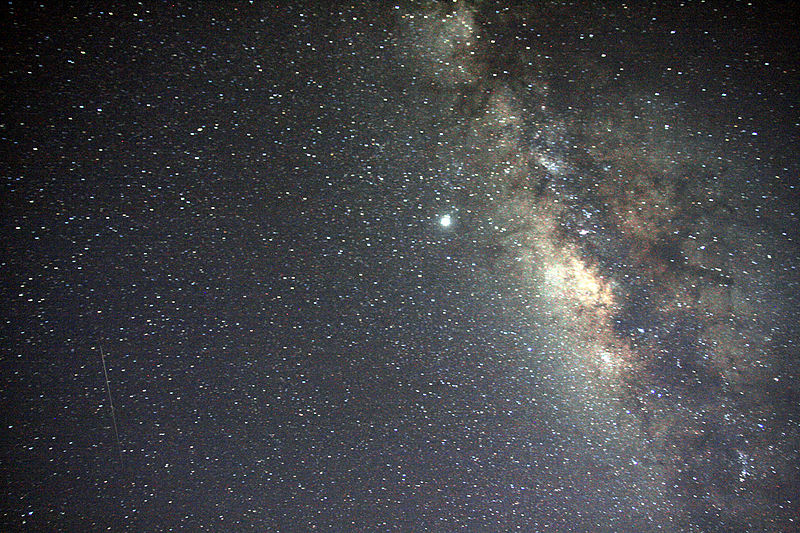
            Via lactea is the Latin name from which The Milky Way is derived. Looking up into the night sky far from the light pollution of our cities it is a glorious sight to see, a glowing whitish milk-like swath of light across the night sky. It was unknown and unexplained for most of our history until Galileo in 1610 trained his telescope upon it and was astounded to find that it is actually composed of millions of tiny stars. We see this swath of glowing light across our sky because we are looking at the other stars in our galaxy edge-on from our vantage point in the Orion Spur about two-thirds of the way out from the center of the galaxy.
            So if we are inside how can we know what our galaxy looks like from outside? It’s a bit like trying to see the inside of your own eye. For that there is a special instrument with mirrors and lenses that will let you see the inside of your eye. To know what our galaxy looks like we use the instrument of science to assemble the pieces, the knowledge we have from observations both by eyesight, optical and radio telescopes, and our rational reasoning in such a way that we are reasonable confident we know what our galaxy looks like. But how? We started with the knowledge provided by Galileo that the milky swath across the sky is actually composed of millions of tiny stars. Knowing nothing else we could assume all stars were the same size and brightness and that the apparent brightness and size of a star would depend on its distance from us. Just as when you approach a car or streetlight the light becomes bigger and brighter the closer you get. The same applies to any other light, including stars. Of course some lights are inherently brighter or dimmer so this must be taken into account. Some stars might naturally be brighter or dimmer than others. If we could assign an average brightness to most stars we could then make a calculated guess as to their distance. But how do we know what distance corresponds to what brightness?
            Here’s where a bit of math and trigonometry magic comes in. Not to delve too far into other areas, but once we know the length and size of the Earth’s orbit around the sun we can use that distance to measure the stars. By locating a near-by (i.e. bright) star such as Andromeda and measuring its position against the far distant stellar background from opposite sides of the Earth’s orbit (e.g. measure the star’s position in June and December or any other 6-month interval) we can use trigonometry with the Earth’s orbital diameter and the angle to the star being measured (relative to the background stars) to determine its physical distance from the Earth.

            Given that, we can assume the same relative brightness for the same type of star and calculate the distance to that star based on its brightness and dimming of the light. This technique is called the ‘standard candle’ technique and is used in various guises throughout astronomy. It can be used to measure within our solar system, galaxy or between galaxies depending on what light source is being used as a standard candle.  Simple right? Of course this method is fraught with potential error and assumptions. Assumptions such as all similar stars having the same brightness, interstellar space being free of gas and dust which could affect the brightness of distant stars (this of course we knew, or guessed simply from looking at the Milky Way and its dark areas and wondering why there were no stars there).  More recently we've been able to observe the universe with infrared, x-ray and radio waves which allow us to see through interstellar dust and gas and validate optical measurements and obtain measurements we could never get through an optical telescope. 


The Milky Galaxy

            So to get back to the Milky Way and how we know what it looks like, we can measure the distances to the visible stars and plot them on a three dimensional graph. When we do we get a good approximation of a spiral type galaxy.
We know from Hubble’s discovery of distant galaxies that there are only a few types of galaxies – the spiral galaxy being one of the most prominent. So we make an assumption.

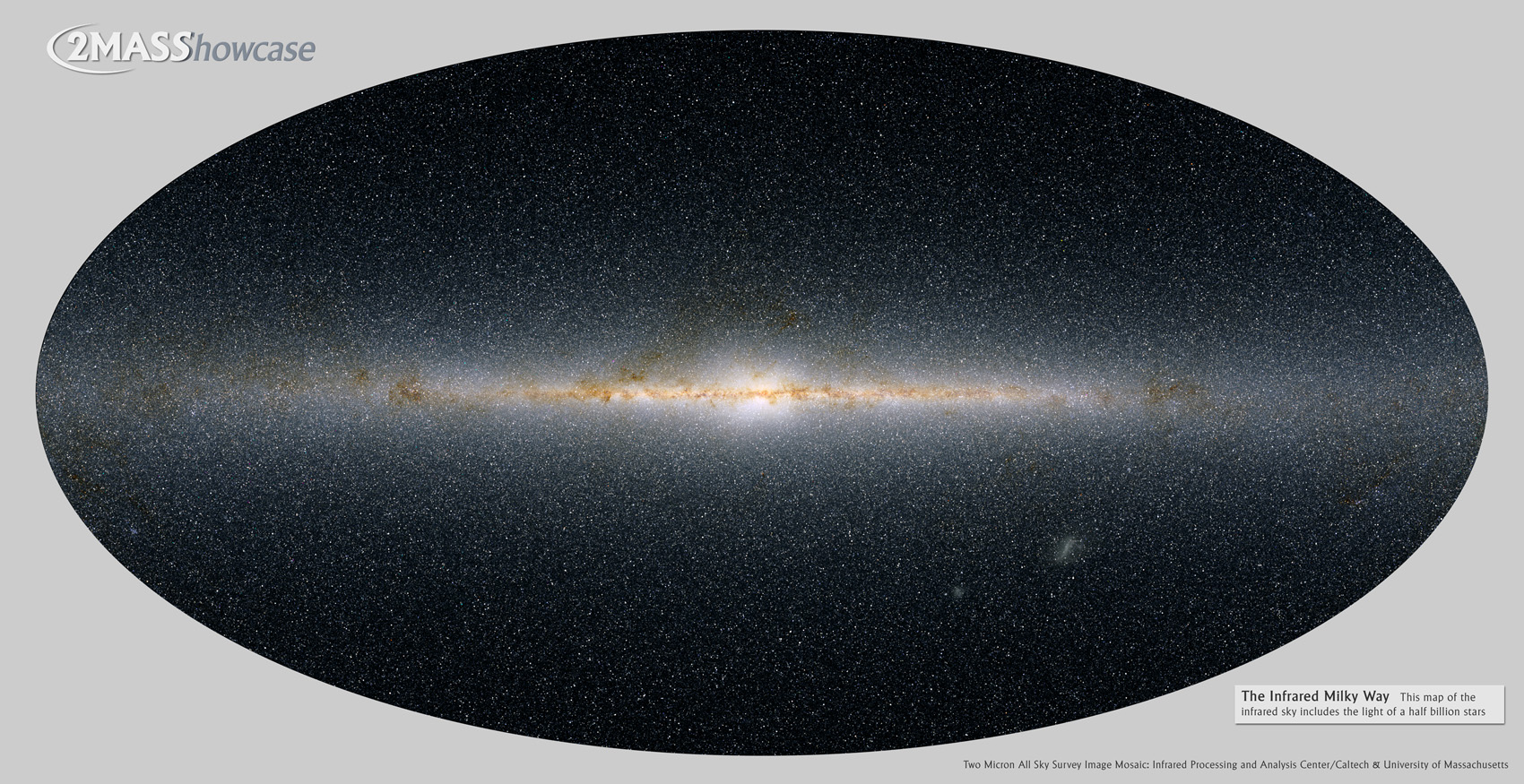
            From infrared surveys (infrared light passes through interstellar dust and gas) we get a reasonably clear picture of our galaxy from our position within it without the dust blocking other stars. 


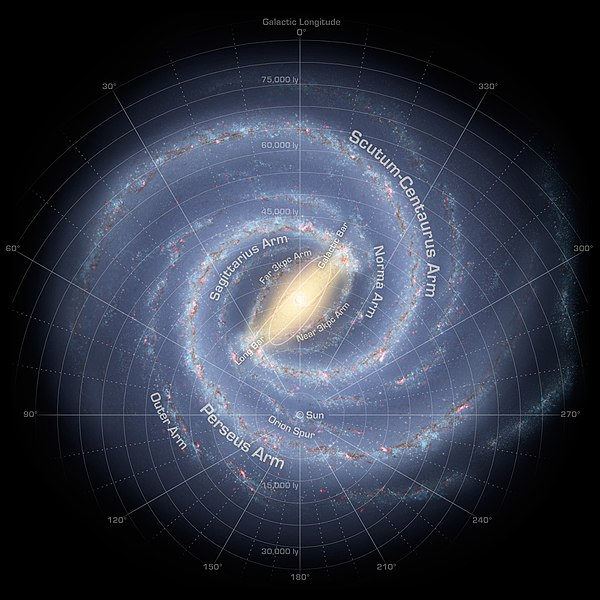
            Additional detailed measurements and plotting of stars reveals further that our galaxy is not a true spiral galaxy, but a ‘barred’ spiral meaning that there is flat rectangle bar of stars extending from the central bulge. Even given our outstanding astronomical equipment there is still controversy over the number and size of the spiral arms and spurs such as the Orion Spur to which our sun and solar system belongs. 


This is a current artist’s conception of our galaxy based on data from NASA. The Sun is located at the lower center with the coordinate graph radiating from it.

            It is thought that there is a supermassive black hole at the center of our Milky Way galaxy just as there are in the centers of other galaxies. There is no danger in this as we are some 25-30,000 light years from the galactic center (depending on the calibration of our standard candles). We still have much to learn about galactic formation and that will be a topic for another of these essays. It could be that the black hole is the reason the galaxy forms around it or alternatively it could be that the gravity at the center of the spinning galactic disc prompts the formation of a supermassive black hole.
Using our radio telescopes, the Chandra x-ray observatory, the Hubble and James Webb space telescopes as well as others in all the various bands of the electromagnetic spectrum we will continue to refine our measurements and knowledge of what the Milky Way Galaxy looks like from outside as well as the interior details. We’ll never actually know for certain what it looks like from the perspective shown above (unless of course we suddenly invent some kind of warp drive that can take us there) but with science we will continue to refine our concepts of our galactic home and what it looks like to others from their homes in galaxies far far away.


References/Resources/Links

Milky Way Galaxy:

Mapping the Milky Way:

Milky Way Galaxy:

2Mass Sky Survey:

Nasa Milky Way Artist Simulation:

Cosmic Distance Ladder (measurement):


About the Author

Kenny A. Chaffin writes poetry, fiction and nonfiction and has published poems and fiction in Vision Magazine, The Bay Review, Caney River Reader, WritersHood, Star*Line, MiPo, Melange and Ad Astra and has published nonfiction in The Writer, The Electron, Writers Journal and Today’s Family. He grew up in southern Oklahoma and now lives in Denver, CO where he works hard to make enough of a living to support two cats, numerous wild birds and a bevy of squirrels. His poetry collections No Longer Dressed in Black, The Poet of Utah Park, The Joy of Science, A Fleeting Existence, a collection of science essays How do we Know, and a memoir of growing up on an Oklahoma farm - Growing Up Stories are all available at Amazon.com: http://www.amazon.com/-/e/B007S3SMY8. He may be contacted through his website at http://www.kacweb.com