Sunday, August 10, 2014

Dark Matters


Dark Matters


by

Kenny A. Chaffin

All Rights Reserved © 2013 Kenny A. Chaffin


Hello darkness my old friend
I’ve come to talk with you again
- Sounds of Silence
by Paul Simon
I
There is no dark side of the moon really.
Matter of fact it's all dark.
- Eclipse (Dark side of the Moon)
Roger Waters


Dark matter, dark energy, the dark side of the Moon…..hmmmm….I think we better talk.  A couple of decades ago everything was cool. We knew the universe was expanding and the thought was that it would either continue expanding or reverse course and begin collapsing due to gravity. In either case it was assumed that the rate of the expansion would slow due to gravity. We’d never seen any slowing so have been looking to verify this claim. Then along comes the damn Hubble Space Telescope screwing everything up! Its observations of distant galaxies in 1998 showed just the opposite. Not only was the expansion not slowing but the rate of expansion was increasing! It was as if some force were pushing the galaxies apart every faster. There was no explanation that fit. Enter confusion and a new hypothesis – Dark Energy -- thrown in to the cosmological mix to explain the accelerating rate of expansion. Now if you’re getting a feeling of déjà vu, blame it on Einstein and his cosmological constant. He claimed it was his biggest mistake – adding it into his general relativity equations and then removing it. It has again been resurrected as an explanation for the accelerating expansion of the universe we now see. Or perhaps this begins to sound more like Roger Water’s Dark Side of the Moon lunatic or maybe Roger Penrose’s quantum mind. It’s all dark, really.
Dark energy is the name cosmologists have assigned to this unexplainable observation, somewhat in relation to the ‘vacuum’ energy of space. This is not science, this is speculation. We don’t know what is going on really we only have observations awaiting an explanation. Dark energy is a hypothesis, not a theory as there is no way to verify it because on its definition.  It only interacts with normal matter in the form of gravity. There is no way to observer it, measure it, or test it beyond the indirect observations of galactic expansion. And how is that different than some unknown feature, force or characteristic of the universe that we simply do not understand at this point? The problem as I see it is that this ‘theory’ of dark energy has been feed to the public in sensational news headlines and popular science articles as if it were real science. This is misleading at best and deceptive at worst in my opinion since it makes it sound like there is a clearly identified cause – dark energy. That is what the public takes from these twitter-like headlines, particularly since most readers don’t get beyond those headlines. The truth is that we don’t know if any such thing as dark energy exists, we have an unexplained observation and that is all we know. Would it not be better to simply say, “Yes the rate of expansion of the universe appears to be increasing but we do not know why?” Unfortunately science is acting more like a religion and claiming that it has answers to the unknown when in fact it does not. In this age of the media and marketing as kingmaker science communicators can fall into the same trap of sensationalizing their stories. But enough of that just call me a lunatic if you like.
Something is responsible for the accelerating rate of expansion of the universe. Something we don’t understand, perhaps there is a cosmological constant that we’ve yet to identify and understand, perhaps there is a problem with Einstein’s General Relativity Equations, perhaps there really is some form of energy here-to-fore unidentified that is pushing the galaxies apart faster and faster. Or perhaps there is some error or issue with our deep-space, deep-time observations.


(Credit: NASA)

            As you can see in the above illustration, measurements show that the direction of the curve changes about 7.5 billion years ago. What might have happened at that point in the universe? Could it be that the ‘vacuum energy’ of space changed at that point due to physical expansion? This is unknown of course. As new space came into being did additional dark energy appear as well? The belief at this point is that 68% of the universe is actually dark energy with another 27% is dark matter. Now it is certainly something of a dark matter that leaves only 5% of the universe as normal matter. That 5% is everything we know, you, me, all the planets, stars, asteroids and hydrogen clouds, everything we previously assumed was the entire constitution of the universe. With the emergence of dark matter and dark energy everything we thought we knew has been turned upside down as though we were in an Alice in Wonderland story.
            Before we go too far, let’s look back at dark matter. It was first proposed by Jan Oort (of Oort cloud fame) in 1932 to account for the orbital velocities of stars in the Milky Way. Others have shown additional situations that require dark matter in order to explain gravitational anomalies. Dark matter doesn’t seem to be as unbelievable as dark energy as it is thought to be ordinary matter which is not easily detectable either optically or by other observational methods. The effect is primarily seen through gravity on orbits, velocities and movement of stars and galaxies. It seems very possible there are massive amounts of normal matter strewn throughout the universe collectively known as massive compact halo objects or MACHOs that could be enough to cause gravitational anomalies but we have not been able to detect enough possible candidates to conclude that this is the case. Another possibility is nonbaryonic dark matter (such as WIMPS – weakly interacting massive particles) which would not be detectible by electromagnetic means. This appears to be the leading candidate for the source of dark matter. While most cosmologists agree that dark matter exists and explains the anomalies there are alternative hypotheses/theories of gravity that attempt to explain the discrepancies without resorting to unobservable matter.


This three-dimensional map offers a first look at the web-like large-scale distribution of dark matter, an invisible form of matter that accounts for most of the Universe's mass. The map reveals a loose network of dark matter filaments, gradually collapsing under the relentless pull of gravity, and growing clumpier over time. The three axes of the box correspond to sky position (in right ascension and declination), and distance from the Earth increasing from left to right (as measured by cosmological redshift). Note how the clumping of the dark matter becomes more pronounced, moving right to left across the volume map, from the early Universe to the more recent Universe. (Credit: NASA/ESA/Richard Massey (California Institute of Technology))

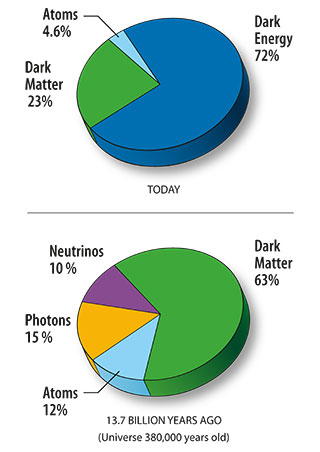
            So the effect of dark energy we observe is somewhat the opposite of the effect of dark matter.  Dark matter has a gravitational pull and effect on stars, planets, galaxies and all normal matter in the same way they affect and attract one another. Dark energy on the other hand creates a constant ‘anti-gravity’ force that pushes everything apart and accelerates the on-going expansion of space. The following illustration from NASA shows the change in composition from the origin of the universe 13.7 billion years ago to what we see today. Note the increasing percentage of dark energy. This sort of makes sense as there was only a certain amount of matter in the original universe and as it expands what is added is space and along with it the vacuum energy which seems to include increasing amounts of dark energy.


            So we have a mystery. It’s a scientific mystery not unlike others that we encounter at the edges of science, in this case the science of cosmology. Dark energy is proposed as a hypothesis to explain the accelerating expansion of the universe though we have no means of measuring, detecting or verifying that that is the case. Dark energy is really just a placeholder for something we don’t understand. It seems to harken back even beyond Einstein’s cosmological constant to the ether theory that was proposed before Maxwell provided us with an understanding of electromagnetic waves. For the non-scientist reading about this research in the media it can be confusing and the casual reader will come away thinking dark energy is a real thing because science said so. Most readers don’t think too deeply about it and figure it’s something like atoms or quarks or photons when in fact it is nothing of the sort. It is nothing more than a hypothesis, and perhaps not even that because to be a true hypothesis it must be testable and from what has been proposed there is no way to test, verify, or validate dark energy. There is only the observation which it is hypothesized to explain – a circular definition in other words. This is the dark side and dark matters.


Afterword

            It is incumbent upon all scientists and science communicators to be as up-front, open and honest as possible with the public. There is a distrust of science that has been building since the mid-20th century. We must take care to not exacerbate the situation in these times of global warming and genetic engineering, these times of political and religious attacks on science. We must work with the public to build bridges of trust and support by stepping out of the darkness and conveying scientific knowledge in the light of truth and full disclosure and thereby regain public trust and support.


References/Resources/Links

The Sounds of Silence:


Dark Energy:


Expansion of Universe Illustration:

Dark Matter:

Distribution map of Dark Matter:

WMAP Content of the Universe graph:


About the Author

Kenny A. Chaffin writes poetry, fiction and nonfiction and has published poems and fiction in Vision Magazine, The Bay Review, Caney River Reader, WritersHood, Star*Line, MiPo, Melange and Ad Astra and has published nonfiction in The Writer, The Electron, Writers Journal and Today’s Family. He grew up in southern Oklahoma and now lives in Denver, CO where he works hard to make enough of a living to support two cats, numerous wild birds and a bevy of squirrels. His poetry collections No Longer Dressed in Black, The Poet of Utah Park, The Joy of Science, A Fleeting Existence, a collection of science essays How do we Know, and a memoir of growing up on an Oklahoma farm - Growing Up Stories are all available at Amazon.com: http://www.amazon.com/-/e/B007S3SMY8. He may be contacted through his website at http://www.kacweb.com


Thursday, May 22, 2014

Butterflies


Butterflies
by
Kenny A. Chaffin


You're a butterfly
And butterflies are free to fly
Fly away, high away, bye bye
                                 -   Bernie Taupin

            Flickering, floating, flying - a river of orange and black as far as the eye can see slips silently from horizon to horizon. The Monarchs are on the move. Their annual migration from Canada to Mexico takes them thousands of miles along well established routes inherent in their genes. Many who begin the journey will never finish it, yet their progeny will continue to follow these same routes year after year, generation after generation.
            Their multi-generational journey covers as much as 3000 miles. Those born in the winter mountains of Mexico traverse only a part of the journey north into the southern United States before mating, laying eggs and dying. Those eggs hatch into caterpillars that eat, grow and transform into butterflies to continue the journey north flying the next leg of the migratory path, followed by another generation who finally reach the northern extent of the Monarch’s range in Southern Canada and the Northeastern United States. Here at the end of their northward journey they once more mate, lay eggs and die. The grubs of this fourth generation grow and transform as before, but this generation is different, it will make the complete 3000 mile trip in a single generation. These southbound butterflies have never made this journey and are three generations removed from those that have, yet they follow the same routes to the same winter habitat in Mexico. It makes one wonder what each butterfly knows if anything of the journey as a whole. Clearly they are following their instincts but we simply do not understand how or why they make their incredible journey. The butterfly lifecycle alone is fascinating; the grubs eating, growing, shedding their skins and growing more and then the caterpillars spinning and building a chrysalis, transforming and emerging as an almost entirely different species.  Of course the caterpillars and butterflies are not different species, their genes have not changed and the vestigial wings, organs and body are all there in the caterpillar. Even so, it is one of the most amazing transformations in the animal kingdom.
            By our best estimates life on Earth began some 3.5 billion years ago, less than a billion years after the formation of the Earth and after ‘only’ an additional 2 billion years multi-cellular life appeared. Because there are no fossils of this early life the estimates and processes are very much unknown and are derived from secondary information such as the beginning of photosynthesis, oxygenation of the atmosphere, geological deposits, DNA, RNA, and other evidence. It is further hypothesized that even the original single-celled life of 3.5 billion years ago was preceded by various abiogenesis ‘experiments’ until one of those experiments resulted in RNA or something like it that was capable of replicating itself. We do know this early life transformed the planet in a complete make-over by creating an oxygen rich atmosphere from the early ammonia and methane atmosphere. And of course none of this happened smoothly. There was a major cooling event 650 million years ago referred to as Snowball Earth wherein the entire planet more or less froze over as seen in the fossil and geological records. Life survived, but the deep freeze definitely put a crimp in its forward momentum. Then about 100 million years later there was an EXPLOSION! The Cambrian Explosion of 530 million years ago resulted in a vast plethora of life forms, species, and all manner of new creatures. Then in the virtual blink of an eye, vertebrates appear at 350 million years ago, dinosaurs at 250 million years ago and of course their demise 65 million years ago due to the Chicxulub asteroid.
            Despite setbacks life continued to plod along; to shift and change and evolve as the Earth’s climate varied and as its continents drifted and shifted. Life was indeed good!  Then some 2 million years ago humans burst upon the scene to wreak havoc on the planet which we’ve been very successfully at ever since.
            It was many years after our first genetic ancestor that the modern human evolved – some 200,000 years ago. We like all species used the tools provided to us by the evolutionary process – primarily our brains, our ability to think symbolically, and our self-directed need to survive. We learned and passed down lessons to our children and our clan-mates. This ability gave us a major competitive advantage and of course we continue to use it despite on-going skirmishes between tribes.
            We learned to control fire, to fashion stone and then steel weapons. We learned how to grow food; How to trade and barter and to band together in groups of common interest. We have spread ourselves across the globe and we build our machines and fortresses that dominate the world. We travel swiftly and easily from one end of the Earth to the other with never a thought as to the miracle we have created. We reach out into space with our probes and our machines. We launch our eyes into the sky to monitor ourselves (and our enemies) and to peer into the depths of the universe.
            While time itself seems to be moving at increasingly faster rates from a technological perspective the universe is much, much older and seemingly never-ending. The vast distances are almost incomprehensible. Our human journey so far is nothing compared to the age and size of the universe. Our best measurements say the universe is 13.7 billion years old and some 93 billion light years across. If we could traverse it at the speed of light it would require 20 times as long as our entire history, including the formation of the Earth itself, the emergence of life and the evolution of humanity. It’s mindboggling to think that solar systems could have formed and produced intelligent life some 20 times during the course of a single crossing of our universe.
            A milestone was recently reached by two of our early space-probes. Voyager 1 and 2 are about to leave our solar system. They are currently some 11.1 and 9.1 billion miles from Earth respectively approaching the ‘leading edge’ of our solar heliosphere and about to enter interstellar space. Some think there will be turbulence at this boundary, their instruments will tell us, but due to the distance we will only know 17 hours later. The Voyagers have proven to be quite amazing machines. They were launched in August (Voyager2) and September (Voyager 1) 1977 and have been operating almost flawlessly for 35 years. The 17 hours their signals take to make the one-way trip means that it requires over a full day to issue a command and get a confirmation back. They are powered by radioisotope fuel cells which are expected to continue working for perhaps another decade before fading away. We’ve already reduced power consumption on the craft as much as possible in order to extend their operational life.
            Just as astounding as the Voyagers are our twin Mars rovers. While Spirit finally succumbed to the Martian winter in March 2010, Opportunity continues to extend its mission (now well into 2013). The Mars Science Laboratory – Curiosity landed using a quite complex landing procedure in August 2012.  It has provided much evidence supporting the belief that conditions may have been conducive to life in Mars’ ancient past and has begun its primary mission, a trek up Mount Sharp. Curiosity is our most advanced rover yet, five times ‘larger’ than Spirit or Opportunity with ten times the mass of scientific instruments. It is about the size and weight of a small terrestrial car. Its planned mission is for one Martian year (23 Earth months), but if our past probes are any indication, we may get much more. As is always the case with our space missions, each is built upon knowledge gained from those that have gone before and using the latest and greatest technology and instruments to provide additional data and ever enhanced experience for constructing our next probes. From each mission we learn, we adapt, and enhance subsequent missions. Always at the core of our probes and rovers are increasingly powerful computing systems, able to survive brutal conditions, capable of error correction and self-repair and with increasing speed, storage and communication abilities as well as ever more sophisticated software and operational capabilities. This autonomous operating capability is increasingly important as we reach further into space and into unknown situations where our rovers and probes must behave in a manner to protect themselves and to continue their missions even when out of touch with Earth.
            Back on Earth there has been an amazing rise of computing capability. Moore’s law says, ‘the number of transistors that can be placed inexpensively on an integrated circuit doubles approximately every two years’ and continues to hold. That in itself does not say much but based on this increasing capability of our computer chips we have increased our software capabilities even more so. Today we have computers in our pockets that have significantly more power than the mainframes of the mid-20th century when the space race began. IBM recently announced their latest supercomputer built for the Department of Defense which brings the title of world’s fastest supercomputer back to the United States. The Blue Gene/Q supercomputer called sequoia at the Lawrence Livermore National Laboratory has 1.57 million Power cores and operates at 16.32 petaflops per second, outdistancing Fujitsu’s K Computer and its 10.5 petaflops. A petaflop is a measure of a computer’ s processing speed and is a thousand trillion floating point operations (such as 13.654 x 11.5) per second. This, like the vastness of the universe is a number hard for mere mortals to comprehend. Also it is difficult if not impossible to compare computer processing and human brain processing because they work in such vastly different manners but, estimates are that the average human brain has about 100 million MIPS (million instructions per second) worth of processing power. Dharmendra Modha, director of cognitive computing at the IBM Almaden Research Center has said, “We have no computers today that can begin to approach the awesome power of the human mind.  A computer comparable to the human brain would need to be able to perform more than 38 thousand trillion operations per second (38 petaflops) and hold about 3,584 terabytes of memory.” This is more than twice the capability of the Sequoia supercomputer mentioned above.  Modha believes that we will be able to simulate some of the workings of the human brain by 2018 – only six years away.
            Keep in mind these supercomputers are still quite unwieldy and require significant support in cooling, electricity, etc. but as we continue to expand our computing horizons and advance the technology there may come a day when we can place this kind of capability in our space probes.
It’s not only computing power that has grown but connectivity and capability as well. Google along with a number of websites such as Wikipedia and You-Tube, have all but replaced the encyclopedia and reference library. And not only that, they are becoming increasingly easy to use. Google already does a reasonable job of interpreting queries but its engineers are working to enhance its natural language processing which will soon make it almost as easy as asking questions of a colleague. Natural language processing is rapidly growing and Apple recently added Siri, its natural language processor to the iPhone.
In an even more impressive feat IBM has demonstrated its Watson computer which was trained to play Jeopardy! and to compete in an actual Jeopardy! game against the two all-time human champions. The outcome was far from assured, but Watson succeeded in defeating his human competitors. It did this by using some very clever natural language processing and automated learning techniques. Standard Jeopardy! questions were asked and Watson had to read and interpret the question as well as determine the solution (in the form of a question). This was particularly tricky because Jeopardy! questions often include subtle, even twisted, word meanings and idioms that the natural language processing software had to understand in order to answer correctly.
            All these advances in computer technology bring us closer to being able to mimic the human brain and give our machines thinking and reasoning capabilities ever closer to our own. One might ask is that the reason we do this. Are we trying to replicate ourselves? Or is it just another aspect of our drive to explore, learn and evolve?
            We might ask the same of our space exploration, our technologies, our societies, are we driven to explore, to reach out, to grow, to learn? Or is there something more to this and all of our human activities, building governments, societies, recording history, exploring everything from quantum mechanics to cosmology? Carl Sagan once said, “We are a way for the cosmos to know itself.” And that certainly may be the driving force behind our human endeavors, but given our extremely brief existence – a few thousand years of recorded history compared to the 13.75 billion year old cosmos – what do we know of our journey. Are we humans like the Monarch butterfly, only one leg of a vast cosmic journey? Are we caterpillars in Earth’s cocoon building machines in our likeness, embodying them with our own intelligence, our knowledge, our capabilities, in essence becoming them in order to reach out, to explore and to take that next step in our journey, as butterflies to the stars.


About the Author

Kenny A. Chaffin writes poetry, fiction and nonfiction and has published poems and fiction in Vision Magazine, The Bay Review, Caney River Reader, WritersHood, Star*Line, MiPo, Melange and Ad Astra and has published nonfiction in The Writer, The Electron, Writers Journal and Today’s Family. He grew up in southern Oklahoma and now lives in Denver, CO where he works hard to make enough of a living to support two cats, numerous wild birds and a bevy of squirrels. His poetry collections No Longer Dressed in Black, The Poet of Utah Park, The Joy of Science, A Fleeting Existence, a collection of science essays How do we Know, and a memoir of growing up on an Oklahoma farm - Growing Up Stories are all available at Amazon.com: http://www.amazon.com/-/e/B007S3SMY8. He may be contacted through his website at http://www.kacweb.com


Friday, January 24, 2014

Watching the River Flow

Watching the River Flow

(from: How do we know? A few things we've learned from science. Available at Amazon.com: http://www.amazon.com/know-things-learned-science-ebook/dp/B00DTIEZYW )

by

Kenny A. Chaffin

All Rights Reserved © 2013 Kenny A. Chaffin


Oh, this ol' river keeps on rollin', though,
no matter what gets in the way and which
  way the wind does blow,
and as long as it does I'll just sit here
and watch the river flow.
                                               – Bob Dylan


            What is it to be conscious? As you read this are you aware that you are reading? Can you feel your toes? Are you aware of your heart beating, your breath? Do you notice these things singly, individually, sequentially or as part of a mosaic of awareness?
            Where do you think ‘you’ are? In your brain? In your chest? Or maybe just behind your eyes. Close them. Are you still there? Are you still in the same place or have ‘you’ shifted? When you touch something with your fingers, feel the texture where are ‘you?’ Is it ‘you’ feeling the texture or ‘you’ knowing that you are touching/feeling the texture under your fingers? Or is it both? Are you the water, the river or are you just sitting there contentedly watchin’ the river flow?
            As you might know already, philosophers have had a field day with this topic since at least the time of Descartes and his famous ‘I think therefore I am’ bifurcated the mind and brain; certainly not just with those words but just as certainly as the church bifurcated body and soul. We’ve struggled ever since to return to a rational view of the mind and consciousness. Why?
            Mostly it’s from our anthropomorphic centrism which continues to rear its head from Copernicus to Hubble, Freud to Jung, and Newton to Schrodinger. We all want to feel and be special. We want our place to be special, our thoughts to be special. Oh sure we are each unique, each with our own quirks, crooked smile and mannerisms, but this is a deeper sort of ‘special.’ We each feel as if we will go on forever as a unique individual -- even when sleeping and we perchance to dream we still are ‘ourselves.’ This comparison of the mind and the soul is not one of happenstance but one of erudite reasoning. Many want to equate the mind with the soul and often do so in passing and without thinking too deeply about it; they want their essence to live forever. It can in a manner of speaking, but certainly not in any corporeal or incorporeal manner. The only way at present for a mind to live forever is by recording in writing, in audio or video as much of that unique mind and perspective on reality as possible. There may be other ways in the future, but as it currently stands literature and recordings are the only way to live forever (and that is only for as long as those recordings endure). Compared to the age of the cosmos, human lives are nothing but a tiny flash of light, a dust mote flaring up in a flame, nothing to be concerned with, yet we each in our own minds want to think we are important, we are special, we are the center of the universe. This was the driver in those early days of self-examination of the human mind.
            Descartes though self-examination in 1637 (influenced certainly by his own devout Catholicism and the religious beliefs of the day) concluded that the self was something separate from the body, separate from the mind and summed it up with "Cogito ergo sum" – I think, therefore I am. This and the idea of the religious soul created the philosophy of dualism. Separation of mind and body, mind and brain. Essentially all his philosophical work focused on this conclusion which says the only thing that can be shown is that ‘thought exists’ – therefore self exists, therefore soul exists. What I find fascinating with this is the question of who it is this is being ‘shown’ to. All else other than thought (other people, all sensation, the world around us, the universe itself) could be deception. In other words he retreats into himself and declares pure thought and consciousness along with subjective, deductive reasoning to be the only true thing. This position while undoubtedly philosophical seems clearly a result of his religious beliefs and his anthropomorphic centrism. Certainly a similar path of thought led to belief in gods and religion centuries earlier with the result being the world’s religions based around this core of an everlasting self. Amazingly there are a plethora of philosophers even today who continue to pursue this path. David Chalmers is one. He seems to have picked up the baton and is leading the charge restating Descartes position as what he calls the ‘hard’ problem. Basically his claim is that subjective experience can never be examined or explained by science. He and others of the same mind-set follow this subjective internal reasoning belief in an attempt to separate mind and brain. To essentially take the same dualistic stance as Descartes to claim that consciousness and the mind are something separate from the brain. They believe and have stated that neurologists will never be able to measure or demonstrate consciousness as a function of the brain. This all seems a smokescreen and ruse to me to protect their academic turf or some such thing. I find it hard to believe that anyone could make such a claim and expect it to be seen as science.  
Daniel Dennett a philosopher himself finds it hard to believe as well and continues to fight against these non-scientific claims. There is no scientific evidence to support dualistic mind/brain in any manner yet they continue to make the claim that science will never explain consciousness. Let’s first look at a few facts.
Our brains are approximately 1200 cc in volume and contain over 80-100 billion neurons, each connected to thousands of other neurons forming a massively parallel multiprocessing organ. Now certainly we do not at the present time have the ability to measure all neuronal firings or neurotransmitter and inhibitor concentrations of the brain in real time. Nor could we even attempt to do so without destroying the brain itself. Yet if we were capable of that level of monitoring then almost certainly we’d be able to explain the workings of not only consciousness, but of memory, dreams and other cognitive processes as well.
            Dennett in his book “Consciousness Explained” and in numerous papers, articles and interviews since its publication, details this controversy from his position of evolutionary materialism. Consciousness exists; it exists throughout the animal kingdom at various levels and has developed as a natural survival mechanism. It is nothing special. We can’t yet specify exactly the neuronal or brain functions that describe it, but that is no reason to invoke mysticism (dualism). As with any science there are things we do not yet know and science is perfectly willing to accept that unknown while it continues to search and investigate in hopes of learning more. Unlike religion and philosophy, science does not make up unsupportable answers for question it cannot address.
            All living things have some form of awareness, they must in order to live and survive. They must be able to distinguish between self and surroundings. Now this rudimentary self-awareness may not be in the same conscious manner of awareness as it is in creatures with dedicated nervous systems but the result is the same. Even single celled animals are capable of identifying food sources/particles, surrounding that food with pseudopods and absorbing it to provide fuel to grow and reproduce. Plants turn their leaves to the sun and sink their roots into nutrient rich soil. The cells in any complex organism are constantly communicating with each other via protein and enzyme messages released and absorbed across their cell boundaries. In short they are aware of what is themselves and what is their environment and they make the most of it. As we move ‘up’ the tree of life the capabilities, awareness and abilities increase dramatically. Common to them all though is that they share this core awareness of self and environment up to and including human consciousness.
            If we look across the depth and breadth of living things we see that beyond simple awareness there are a plethora of refinements and enhancements that spring from environmental awareness due to evolution. These adaptations create a full spectrum of awareness and consciousness from virus awareness of environment to human self-consciousness.
            Consciousness on the surface seems quite simple. When you are awake and aware as opposed to asleep or sedated or in some other altered state you are conscious. And while that is a perfectly usable definition if we dig a bit deeper things start to get more complicated. Brain wave monitors (electroencephalographs EEGs) have identified a variety of common brain states based on the frequency, location and duration of neuronal firings in the human (and other animal) brains. These are very large-scale indicators of major brain activity. They tell us nothing about the details of thought, memory or sensation. They were however the first indicators of brain states such as consciousness, awareness, relaxation, active thinking and problem solving. Early studies identified brain characteristics like alpha waves, theta waves, delta waves which each fall into a defined bands of frequencies and were found to correspond to various brain states like alertness, sleeping, focused problem solving, fear and others. Ongoing work in monitoring, imaging using CT-Scans and fMRI among others and studying brain activity has continued to bring us more detail about the specifics of brain and neural processing. The biggest issue is the extreme complexity of the brain. The human brain consists of lobes and sections to which certain activities and abilities are associated. It is as though there are multiple brains built one upon the other. In comparing the brain anatomy from various creatures, including humans it is evident that there are ‘older’ and ‘younger’ sections of the brain. This makes sense from an evolutionary perspective. Our ‘reptilian brain,’ the cerebellum is the oldest and physically the lowest part of the brain just off the brain stem which itself is even older from an evolutionary perspective. The cerebellum in turn is covered by the cerebrum and the neo-cortex. The ‘older’ parts of the brain are responsible for the more basal functions of life such as breathing, heartbeat, maintaining body temperature and metabolism. These are mostly all handled with little to no awareness by our consciousness yet are far from isolated.
 File:Gray720.png

If your breathing is stopped it is the cerebellum that initiates the disaster signals that trigger action in all areas of the brain and you are suddenly and fully aware and conscious of your need for air. Slightly more subtle can be the flight-or-fight response to a perceived danger. You might see a saber-toothed tiger lurking in the bushes ahead, your cerebellum immediately and without your direction begins preparing your body for survival. Your heartbeat increases, you senses become ever more alert, your muscles prepare to run or defend yourself. As you become aware of the situation you may over-ride any immediate action by freezing and thinking, or you may not, you may just run in terror. All of these things have aspects of both consciousness and unconsciousness about them. Normally we are not aware of our breathing or heartbeat but we can focus our attention on them and control them to some extent.
            Clearly memory, a separate mental function, plays into consciousness as well, such as ‘what did that last saber-tooth tiger I escaped from do?’ Or while you are thinking about that last encounter the tiger may already be upon you. Survival has to do with many things, many decisions both by evolution and by intelligent awareness.
While it would seem that most researchers agree that consciousness is that alert, aware, focused state of mind that is monitoring and reacting to real-time (or sometimes memory) events, there are a number of medical and research studies that might put this into question. Two of the more well-known ones are split brain and blindsight studies.
            Sometimes in order to stop seizures it is necessary to separate the two halves of the brain surgically. The seizures are like electrical storms in the brain which can rage out of control sending multitudes of signals in random patterns throughout the brain. Sometimes by severing the connections between the brain halves the storm can be stopped in its tracks and allow for a reasonably normal life for the patient. This is done surgically by severing the corpus callosum which connects the two halves of the brain. Where this becomes interesting to consciousness is when tests are done in the laboratory which separate the left and right halves of the sensory input to the brain. Since each half of the brain is responsible for the opposite half of the body it becomes very interesting to test awareness of sensory inputs and what the patient is conscious of in their regard.
            For example, a divider might be placed between the patient’s eyes and images displayed on a computer screen to one eye or the other or both.  This classic study which won the Nobel Prize was done by Roger Sperry in the 1950s. Images show to the right eye/side could be named properly. Images shown to the left side could be drawn by the left hand, but not named. Similar results were found with touching/holding objects like a key or a block. The subject could name the object if placed in his/her right hand, but could not name the object if placed in their left hand. Yet when asked for find the object with their right hand among a group of objects they could unfailingly find it, even though unaware of it and unable to name it. So what does this say about consciousness?
Sperry concluded that there seemed to be two separate streams of consciousness – one in each hemisphere of the brain. It seems from these studies and others that followed that consciousness is linked to language processing at least as far as being able to communicate and be aware of that consciousness. By the same token there is clearly an awareness of sensory input that can be used non-verbally and apparently without awareness by the subject to answer questions (e.g. selecting the correct object with the opposite hand). From this it would seem that our normal consciousness, our self-awareness is only that awareness that is processed by the language-understanding part of our brains in the left hemisphere.
            Blindsight studies are similar and are typically done with subjects that have had one half of the visual context (i.e. one side of the brain) damaged or destroyed through, disease, stroke, etc. Results are similar in that subjects appear to be able to respond to visual stimuli from the blind eye or eyes without any consciousness awareness of sensory input or cognitive processing. In a study with a monkey as cited in the reference section, the monkey’s visual cortex was completely removed. And certainly she could no longer see but still displayed ‘sighted’ behaviors such as protecting her eyes from threats/injury and was at times able to respond to visual stimuli and even navigate through her environment avoiding obstacles. Studies with human subjects have shown similar results. Identifying objects (though not consciously) and navigating in such a way as to avoid obstacles. 
            So what happens to consciousness when you sleep? Clearly by experience and by brain-wave monitoring you are not conscious, yet there are dreams that you often remember upon awaking (clearly identified as dreams, as opposed to memories of real events or experiences). Normal sleep is a very different experience than being under general anesthesia wherein time seems to simply stop, leaving a blank nothingness whereas with sleep it seems one is still aware of passing time.
            What of other altered states of consciousness? Falling-down drunk or high as a kite? Seems they are somewhat similar to sleeping or possibly being anesthetized. When the awake/aware/consciousness is impaired we are not fully conscious. So is it then consciousness that is ‘us?’  Is myself only my consciousness or something more, or different? And what does neurology say?
            We do not yet have any significant results from the Human Brain Mapping project which was initiated this year (2013) by President Obama, there is a similar initiative taking place in Europe and there is much anticipation that the results will be on the same order of magnitude as those of the Human Genome project. Still there is and has been significant research into brains, human and animal alike and not by p-zombies either, by actual scientists such as Stanislas Dehaene and Lionel Naccache who in their paper “Towards a cognitive neuroscience of consciousness: basic evidence and a workspace framework” lay out the basis of understanding consciousness from a neuroscience perspective in a clear and straight-forward manner (see the reference section for a link to the paper). They say,

“…the problem of the cognitive neuroscience of consciousness does not seem to pose any greater conceptual difficulty than identifying the cognitive and cerebral architectures for, say, motor action (identifying what categories of neural and/or information-processing states are systematically associated with moving a limb).”

As to the obstacles:

One major hurdle in realizing this program, however, is that we are still in the grip of a residual dualism∫ (Searle, 1998, p. 1939). Many scientists and philosophers still adhere to an essentialist view of consciousness, according to which conscious states are ineffable experiences of a distinct nature that may never be amenable to a physical explanation. Such a view, which amounts to a Cartesian dualism of substance, has led some to search for the bases of consciousness in a different form of physics (Penrose, 1990.”

            While they lay out a framework for studying consciousness from a scientific perspective, much work has already taken palace and continues. Increasingly detailed scans of the brain (generally while doing specific tasks) with CAT scans, MRI and fMRI scans are filling in gaps in our understanding. FMRI scans in particular allow scientists to see which areas of the brain are most active based on blood flow. Unfortunately the resolution of fMRI scans is only 2-3 mm which is huge compared to individual neurons which are only 4 to 100 micrometers (.004 - .1 mm). Other scanning techniques such as PET scans can detect individual radioisotopes and thus specific neurotransmitters at synapses but require use of radioisotopes and looking at very specific areas. These techniques are further advancing our understanding of how the brain operates and will certainly contribute to the understanding of consciousness
            We are almost daily getting closer to the holy grail of being able to duplicate the brain’s functionality and capacity (e.g. the number of neurons, their functionality and interconnections). Many neuroscientists and computer scientists think we may be capable of this feat by mid-century 2050 or so. Does that mean we would be able to duplicate or transfer a human brain into a computer? Not very likely. There is still much we are learning about the brain, how neurons work and the vast complex interconnected multiprocessing biology of the brain.
            Much work is taking place in the computer and artificial intelligence area. These are not always and not often consciousness type work, but there is much work in implementing neural network type systems which are modeled after the way the brain is wired. They simulate neurons, synapses and massive connectivity.
            Other areas where computers are informing the investigation of consciousness are in natural language understand system (sometimes neural networks as well). One recent example is the Watson system from IBM which defeated the all-time Jeopardy! champions. It is a massive system capable of understanding the often ambiguous questions and formulating answers (in the form of a question) from its mass storage (which includes a large part of the internet – Wikipedia, dictionaries, and encyclopedias stored locally as part of the Watson system).
            Recent attempts at duplicating the brain or sections of it are making progress as well. The Blue Brain project at the Brain and Mind Institute in Lausanne, Switzerland is attempting to create a synthetic mammalian brain down to the molecular level. As of July 2011 they have created a cellular mesocircuit of 100 neocortical columns with a million cells in total. The plan is to duplicate a rat brain rat brain by next year 2014 with 100 mesocircuits totaling a hundred million cells. They expect to create the equivalent of a human brain by 2023 which would be 1000 times the size and capacity of the rat brain.
             Some interesting work is being done by Alice Parker, a USC electrical engineering professor with carbon nanotubes. She and her team have been able to create a transistor from these carbon nanotubes which behaves like the synapse where two neurons meet. This could have significant implications for future brain simulations. Duplicating the synapse between neurons which operate by electro-chemical interaction and enhancement and inhibition by neurotransmitters is a significant hurdle to be overcome in duplicating the functionality of a brain
            So what then of consciousness? What do we take from this examination? Perhaps it is that consciousness is a small part of what we, as well as all other animals are. An important part certainly, a part we would all dearly love to live on forever despite everything we know indicating otherwise. Still if nothing else we can live on in the memory of others, possibly in the things we leave behind, our writing, our images, and our thoughts in some manner or another. If we have children our genes will be passed on as they were passed to us from our parents. Life is a continuous sequence with each of us a single link in its chain. Our thoughts too, informed by family, friends and all we experience both internally and externally become part of our mind and are accessible to our consciousness. Parts of that we can pass on for some fleeting time through our work, through those who have known us and through the things we leave behind. We each are only a tiny eddy, a tiny ripple in the river of life which flows on with or without us, we each take our existence from that river and return to it and on it flows whichever way the wind does blow. As for me, I’ll just sit here contentedly and watch that river flow.


References/Resources/Links

Consciousness:

Brain Waves:

Split Brain Studies:

Blindsight:

The Hard Problem of Consciousness:

AI, computer brain simulations, etc:


The Blue Brain Project:

Towards a cognitive neuroscience of consciousness: basic evidence and a workspace framework:


Neurons:

Neuroimaging:

Brain Drawing Image:
About the Author

Kenny A. Chaffin writes poetry, fiction and nonfiction and has published poems and fiction in Vision Magazine, The Bay Review, Caney River Reader, WritersHood, Star*Line, MiPo, Melange and Ad Astra and has published nonfiction in The Writer, The Electron, Writers Journal and Today’s Family. He grew up in southern Oklahoma and now lives in Denver, CO where he works hard to make enough of a living to support two cats, numerous wild birds and a bevy of squirrels. His poetry collections No Longer Dressed in Black, The Poet of Utah Park, The Joy of Science, A Fleeting Existence, a collection of science essays How do we Know, and a memoir of growing up on an Oklahoma farm - Growing Up Stories are all available at Amazon.com: http://www.amazon.com/-/e/B007S3SMY8. He may be contacted through his website at http://www.kacweb.com

He may be contacted through his website at http://www.kacweb.com

Wednesday, October 30, 2013

Artificial Intelligence

Artificial Intelligence

(From my science essay collection How Do we know? )

by

Kenny A. Chaffin

All Rights Reserved © 2013 Kenny A. Chaffin


            The first Alien Intelligence we meet may not be from another planet, but from our own computer labs. Many of us walk around with a computer in our pocket capable of listening, parsing, and responding – sometimes even correctly – to our voice. We Google for information by typing in phrases, sentences or disconnected words and the artificial intelligence in Google’s search engine almost always comes back with what we are looking for. These dedicated applications are on the verge of intelligent behavior and could certainly in their domain be called intelligent. Other systems are even more so and in some cases demonstrate more generic intelligence such as the Watson system from IBM that recently defeated the all-time Jeopardy! champions. So how soon until we get to meet these Alien Intelligences of our own creation? We could see them perhaps within the century and almost certainly (provided we don’t kill ourselves off or get whacked with an asteroid) by next century. A Watson-like system is being rolled out by IBM to assist in medical diagnosis. Google, Google Voice, and Siri will continue to improve. New research into machine learning, user interfaces and the human brain are being brought from the lab into practice. It’s been a long and bumpy road, at least by technological progress measurement since that first Dartmouth conference on machine learning in 1956 when Marvin Minsky boldly predicted that "within a generation ... the problem of creating 'artificial intelligence' will substantially be solved." Other bold predictions followed every few years, then every decade until with little actual success the predictions stopped. In some ways that was when the work really began. And that work as often happens emerged not from the expected avenues, but from the back allies and offshoots of other research.
            Artificial intelligence is defined as a branch of computer science dealing with the simulation of intelligent behavior in computers. John McCarthy, one of the Dartmouth conference organizers who coined the term defines it as "the science and engineering of making intelligent machines." The founding idea was that the central feature of humanity – intelligence – could be analyzed, described and simulated by a machine. The core issues of accomplishing this have to do with perception, communication, analysis of sensory input, reasoning, learning, planning and responding to real-world events. The ability to perform these functions in a general manner (like a human) is known as Strong AI though much of the work and research is done as subsets of the larger goal. There are a number of associated areas as well such as neuron simulation, learning theory and knowledge representation.
            The key of course is understanding intelligence, what it is, what it does, and perhaps even why it does what it does. But it is a bit like art or pornography – “I may not be able to define it for you, but I can certainly tell you what it is when I see it.” There are many often disparate definitions of intelligence, but what seems to be the core is problem solving. It involves identifying a problem or obstacle, seeking or creating a solution, applying that solution and then evaluating the result. The evaluation provides a feedback process to inform future decisions.
            The artificial intelligence field got its start at the Dartmouth conference with four key figures – Alan Newell, John McCarthy, Marvin Minsky, and Herbert Simon all of whom were computer scientists with exception of Simon who was more of a psychologist/sociologist as well as being knowledgeable in other disciplines. All of them were in fact somewhat cross-disciplinary. This idea of building a machine capable of human intelligence came not long after the advent of the first practical computers. Given the broad capabilities exhibited by computer programming as a result of the Von-Neumann architecture based on Alan Turing’s mathematical concepts it seemed quite possible to program a computer to emulate human intelligence and decision making. But oh what a tangled web was to be weaved from this.
            Throughout history there have been numerous attempts, desires, stories and examples of building or bringing inanimate objects to life. There are clockwork robotic devices, statues and puppets and trees that came to life (Pygmalion, Pinocchio), the mechanical devices built to simulate/emulate/recreate human behavior sometimes even with dwarves or children inside to huckster the crowd, and back beyond even that to the oracle at Delphi. Given all the literature, myths, stories and actual devices there must be something very deep in the human psyche that longs to re-create itself. Perhaps it is even down to the genetic drive of reproducing, recreating, perpetuating ourselves, perhaps a kind of genetic imperative drives our attempts, our need to explore artificial intelligence.
            Nevertheless the work seriously got underway following the Dartmouth conference and there was serious money behind it, primarily funded by the departments of defense in the United States and in Britain as well as Russia and other world powers of the mid-20th century.
            The perceived promise led Darpa to invest approximately $3 million a year from 1963 to the mid 1970’s. Similar investments took place in Britain. Darpa of course was looking for potential military applications during this cold war time of tension around the world. The promise and the culture of the time though led to a devastating situation. The funds flowed with little oversight and the field went in many directions that resulted in little applicable output. This was the early days of computers and the algorithms and programs designed to emulate things like human logic and reasoning were quite complex and resource demanding. They did not work well on the hardware available at the time. Either the programs had to be scaled back and limited in their scope or very long time-frames had to be allowed in order to get results. Neither came close to approaching the abilities of a human brain on any level. Sensing capabilities such as vision and audio which were being worked on as a subset of the AI problem required massive programming just to acquire and manipulate the data into a form that could be used by the AI components. 
By the mid 70’s the faltering field was stripped of funding and mostly dropped. This in now known as the first AI Winter and would last almost a decade until the early 80’s. Some work continued, but without the freely flowing funds it was much more focused and more a labor of love rather than more random experimentation. During this time as well much criticism was leveled at the computer scientists by other academic departments. Philosophy, psychology, biology and mathematics all took shots, but by the same token they were all interested in the field that they had been shut out of in this early phase and as a result many research institutes began bringing together diverse cross-disciplinary groups to work on the research as well as providing means for them to work better together. As a result we get learning specialists helping to design computer learning applications. We get knowledge management experts helping to devise search and storage hardware and software. And we find neurological experts working with programmers to simulate neural networks.
This ‘background’ research led to the next step in AI  - Expert systems, which were the rage in the 80’s. An expert system was intended to be a subject matter expert in a specific or limited domain. It incorporated a knowledge base and a means of searching and retrieving (as well as updating) information. This lead to a boom in database research and development. Computers were rushing along following Moore’s Law of doubling capabilities every two years. This allowed for more complex search algorithms which were ever faster as were the database search and retrieval. The programming language of choice for these systems was Lisp a symbolic manipulation language thought to better model thought processes, symbolic manipulation and such. Certainly there was some success for these expert systems but again the result failed to match the expectations and once more the field floundered.
In the meantime Japan initiated the Fifth Generation Computer Project which was intended to create computers and programs that could communicate using natural language, do visual processing and recognition as well as emulate human reasoning. They dropped Lisp and chose a newer language Prolog as the core programming language perhaps to leave the old ways behind and start anew. Other countries responded in kind to this ‘threat’ of computer dominance. During this time much work was beginning to focus on neural networks and emulating the brain in hopes of breaking free of the step-by-step von-Neumann style of programming. This took place (and continues to this day) in both hardware and software. Emulating the workings of individual brain neurons as well as connecting them in the manner of a biological brain. But again the lack of substantial applicable results to business or military uses brought on another ice-age. The second AI Winter lasted from the late 80’s to the mid 90’s.
By this time the field of robotics was rising particularly due to the use of robotics in assembly factories such as car manufacturers and electronic assembly plants. There was money to be had for robotics research and a new slant on the AI field emerged. By providing the means to these factory robots to handle ambiguity, recognize defective parts, to align and assemble them properly without supervision or through extremely precise programming and logistics provided a new venue to AI. It wasn’t just emulating human intelligence and reasoning, but performing the tasks a human would do in a real-world assembly factory.
A separate but similar revolution was taking place in space exploration. Our robotic probes to Mars, Venus, Saturn and the outer planets were being designed with increasingly autonomous and error-correcting capabilities. These robots – rovers and probes of various styles had to operate autonomously in much more demanding and dangerous situations than the factory floor. NASA and the military funded some of the best minds, universities and corporations to build these mechanical emissaries to the cosmos. 
  There was a completely different revolution taking place during these years as well. From the mid/late 80’s the business demands for data storage and retrieval have exploded like a sun going nova. This fueled much database research and even special purpose hardware research such as Teradata and Britton Lee database machines. The advent of the internet brought search engines to the fore and the star of course that emerged was Google now a household name/word and verb equivalent to internet search. The massive data problem is far from solved, it continues to grow. Everything has gone digital. Businesses store all their corporate data digitally, our space telescopes produce massive amounts of data as do research projects such as the Human Genome Project and other DNA and biological analysis research as well as the recently announced Human Brain Mapping initiative. This issue is known today as the Big Data problem and significant amounts of cash from government and private industry are pouring into managing the problem. The results of this are applicable as well to AI research because one of the obstacles is providing and managing the amazing amount of information storage required to emulate a human brain.
A human brain has about the same number of neurons as there are stars in the Milky Way galaxy – about 100 million. And each of these neurons may be connected to thousands of other neurons. This creates an amazingly complex multi-processing system that is not only difficult to emulate but requires computing capabilities that are currently beyond present-day systems. We may see it in the next half-century though.
All of these areas of research and application are at the fore-front of today’s computer, information and cognitive science. Google is increasingly capable of parsing and analyzing natural language inputs and providing (in extreme short time-frames) relevant results. We have cell phones that are capable of processing speech input and providing similar search results or actions based on the spoken words. Our robots are exploring Mars, Voyager (launched 35 years ago) is still functional and approaching the edge of interstellar space. It requires 20 minutes for radio messages to travel to or from it. The autonomous land vehicle trials by Darpa and Google continue. Google’s vehicle has already been given approval for commercial operation of these vehicles in several states.
It seems we are now approaching real AI – the capabilities of humans from several oblique angles following failures of direct methods of programming rational decision making, expert systems, and embedded logic. It seems that real AI is coming not from the research labs, but from the factory floor, our autonomous space probes and vehicles, and from our information management needs. We continue to attempt to emulate the physical structure and workings of the human brain but some of our best results are in our pockets -- our cell phones with voice-actuated access to the world’s knowledge at the tip of our tongues.


References/Resources/Links

Artificial Intelligence:

History of Artificial Intelligence:

Watson:

Human Brain:

Human Brain Mapping:


Blue Brain Project:


Neural Network Software:

Expert Systems:

Strong AI:

Big Data:


About the Author

Kenny A. Chaffin writes poetry, fiction and nonfiction and has published poems and fiction in Vision Magazine, The Bay Review, Caney River Reader, WritersHood, Star*Line, MiPo, Melange and Ad Astra and has published nonfiction in The Writer, The Electron, Writers Journal and Today’s Family. He grew up in southern Oklahoma and now lives in Denver, CO where he works hard to make enough of a living to support two cats, numerous wild birds and a bevy of squirrels. His poetry collections No Longer Dressed in Black, The Poet of Utah Park, The Joy of Science, A Fleeting Existence, a collection of science essays How do we Know, and a memoir of growing up on an Oklahoma farm - Growing Up Stories are all available at Amazon.com: http://www.amazon.com/-/e/B007S3SMY8. He may be contacted through his website at http://www.kacweb.com 


Sunday, October 13, 2013

The Elephants in the Room - Problems with Physics


The Elephants in the Room

by

Kenny A. Chaffin

All Rights Reserved © 2013 Kenny A. Chaffin


Maybe I’m getting crabby or frustrated or impatient but it seems that physics has forgotten its basics. Let’s start with gravity. We become aware of gravity even before we are born and even more when we begin to make our way in the world, rolling, crawling and walking. We are constantly aware of the ‘pull’ of gravity. Examination of gravity rationally and scientifically began with Galileo (though certainly many had thought about it before). He was the first we know of to conduct and record experiments to determine the force of gravity and he supposedly tested dropping balls from the Leaning Tower of Pisa though the majority of his experiments were done using inclined planes and rolling balls. He was able to determine that the acceleration of gravity was constant.
Now let’s jump to Newton. He took our knowledge a step further, to actually mathematically determine the pull of gravity and to show that its action was the same on Earth as in space by describing mathematically how planets and stars interacted. Still he was at a loss as to what the force actually was and how it worked.
Einstein took another giant leap by equating gravity and acceleration and ultimately describing gravity as not a force, but as a curvature of space due to mass. This theory predicted that light would be ‘bent’ when passing near a massive object. We’ve actually seen and measured this as well as observing the effects of gravitational lensing wherein galaxies bend the light of stars around themselves.
Quantum mechanics has another approach. According to the Standard Model there should be a particle – a gravitron – that mediates the gravitational force (note that gravity is a force here not curved space) which appears to be a direct contradiction with Einstein’s General Relativity and its description of curved space.
String theory attempts to take a slightly different angle in an attempt to move beyond quantum mechanics by adding dimensions to space and ultimately trying to define quantum loop gravity (in an attempt to unify relativity and quantum mechanics) as something like a ‘hidden’ dimension of reality. String theory has become extremely mathematically intensive and has yet to meet the true standards of prediction and testability required by science.
Now maybe this gravity issue is just an ‘unanswered’ question of physics. Certainly that is what it seems to be given the contradictory explanations between Relativity and Quantum. But hold this in mind for a bit.

In Special Relativity Einstein ‘set’ the speed of light as constant and invariant due to various properties that physicists had observed – primarily the Michelson-Morley experiment. He pushed this idea further than anyone and developed his Special Theory of Relativity (prior to the General Theory) with its unique results and predictions about light, its behavior and ultimately about time changing depending on the observers position and movement due to the fact that the speed of light must always be invariant regardless of the motion of the observer. This results in some very non-intuitive results, including the ability to (in a manner of speaking) travel into the future. It all seems to be true based on tests conducted with clocks of various types moving at various speeds. The question for me though is why is the speed of light constant and why if photons are massless do they have a finite speed? This is the elephant in the room as is the curvature of space.
Now maybe as opposed to Marvin the Android my tiny brain just can’t comprehend these concepts, but it seems something is missing. It seems that perhaps we need to slow down, back up and rethink. That is a bit what the bad boy of physics Lee Smolin is attempting to do in his approach. He worked for decades in researching and developing String Theory before declaring it the wrong approach. This is detailed in his book “The Trouble with Physics” and continues in his latest release “Time Reborn.” In it he revisits the fundamentals of physics including light, space and time. He has taken the radical approach of declaring Time the fundamental component of reality. In essence he is setting time as real and invariant similarly to what Einstein did with the speed of light. At one point in the book he states that this approach is really just another way of looking at Relativity.
After reading about Special and General Relativity myself for decades (but without any of the mathematical abilities to examine it in detail) I’ve often wondered myself about whether one could simply choose a component of reality as we know it – like the speed of light, time, or space – set it as invariant and work the math required to develop an alternative view of reality just as Einstein did. Now Smolin’s book and view on time is written for the popular reader and he admits that he has not followed through with the mathematics but is putting the idea forward as an alternative possibility in the hopes of someone taking it and running with it.
Along these same lines now comes Dark Matter and Dark Energy to explain a couple of anomalies we seem to observe in the cosmos. Dark Matter is the proposed solution for the aberrant movement of galaxies and stars which appear to be acting as though there were more mass in the universe than is evident from the stars and reflected light we see. It certainly seems possible there is ‘unseen’ matter that might cause this gravitational effect. Another possibility could be that our observation is somehow affected by space or time or other laws of the universe we simply don’t understand yet.
This brings us to Dark Energy, the proposed solution to the recently discovered accelerated expansion of the universe. We’ve known (or assumed we have) that the universe is expanding since Hubble measured and proposed it in 1929. We can measure the red-shift of distant stars with spectrographic instruments and have determined that not only are they all moving away from us (thus implying expansion) but that that expansion is accelerating. This has been confirmed by recent cosmic microwave background measurements. We don’t know why this is happening yet Dark Energy has been anointed as the reason by creating a kind of anti-gravity force ‘pushing’ space apart while at the same time being a force that is undetectable, unmeasurable, and invisible other than through the observation of the foresaid acceleration of universal expansion.
I don’t know about you gentle reader, but this is all a bit unsettling for me. There are many unknowns here and of course as Feynman says that’s okay, it is much better for science to say I don’t know than to create unsupportable, unsubstantiated solutions. I ‘believe’ in science, I trust it to eventually find the answers to the reality of the universe around us but at times I wonder if perhaps we haven’t gotten off the path, I wonder if perhaps we are not seeing the elephants in the room and if perhaps we should not stop, regroup, and reexamine some of our basic assumptions about the world around us.


About the Author

Kenny A. Chaffin writes poetry, fiction and nonfiction and has published poems and fiction in Vision Magazine, The Bay Review, Caney River Reader, WritersHood, Star*Line, MiPo, Melange and Ad Astra and has published nonfiction in The Writer, The Electron, Writers Journal and Today’s Family. He grew up in southern Oklahoma and now lives in Denver, CO where he works hard to make enough of a living to support two cats, numerous wild birds and a bevy of squirrels. His poetry collections No Longer Dressed in Black, The Poet of Utah Park, The Joy of Science, A Fleeting Existence, a collection of science essays How do we Know, and a memoir of growing up on an Oklahoma farm - Growing Up Stories are all available at Amazon.com: http://www.amazon.com/-/e/B007S3SMY8. He may be contacted through his website at http://www.kacweb.com